

The short answer
- The "smell of clean" is a designed fragrance, not a property of clean surfaces.
- Genuinely clean rooms smell of nothing. That is the target, and it is disconcerting at first.
- Masking is not removing. A smell you cover comes back the moment the fragrance fades.
- Smells live in soft things, water traps and the fridge — not in the air you are spraying.
- Ventilation plus removing the source beats every scented product ever sold.
What’s in this guide
Ask anyone what clean smells like and you will get an answer in under a second: lemon, pine, "fresh linen", something blue. That is a remarkable thing for an entire population to agree on, given that none of those smells has any connection whatsoever to the absence of dirt. What we are all describing is not clean. It is a fragrance that was designed, deliberately and quite recently, to make us feel that a job was done — and the gap between feeling and being is where every stubborn household smell survives.
A smell that was invented
There is no natural relationship between citrus and hygiene. A lemon does not disinfect a worktop, and pine forests are not notably sterile. The association exists because cleaning products have been perfumed for generations, and because a scent is the fastest way to tell a customer that something has happened.
That is not a scandal; fragrance is pleasant and people like it. The problem is that it is such a strong signal that it replaces the evidence. A room that smells strongly of lemon is read as clean even when nothing has been cleaned, and — much worse — a room that has been properly cleaned but smells of nothing is often read as not done.
We have trained ourselves to detect a marketing decision and call it hygiene.
Clean smells of nothing
A genuinely clean room is odourless. Not neutral-with-a-hint-of-something: nothing. The air has no story to tell you.
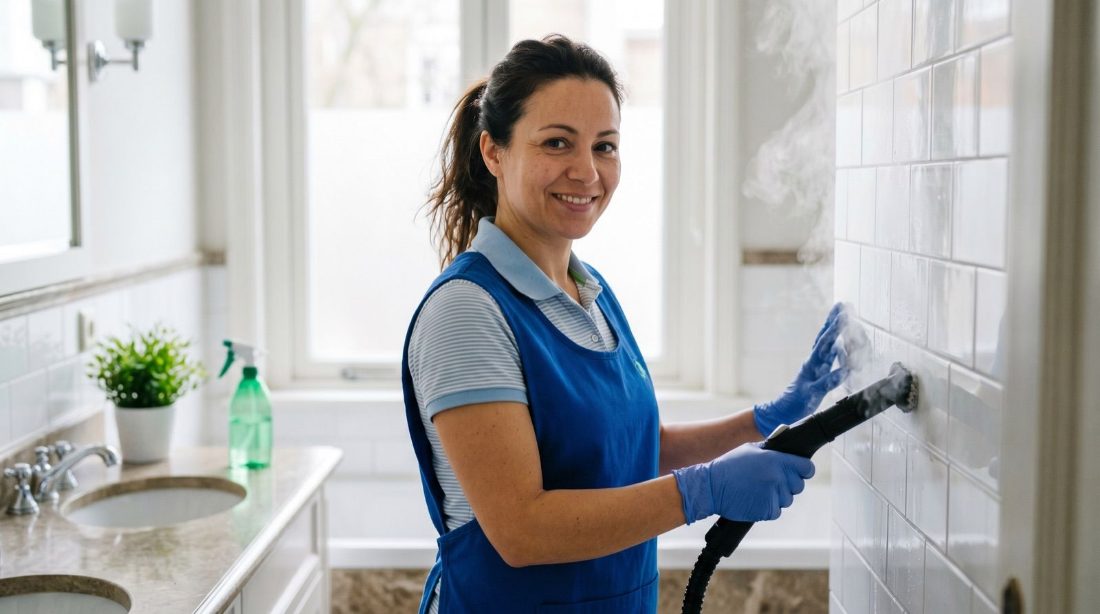
This is one of the odder parts of professional cleaning, and customers new to it sometimes ask whether anything was used at all. Steam cleaning is the clearest example — it sanitises with heat and leaves behind no residue and no scent, so the room comes back smelling like a room. People who are used to fragrance find that faintly suspicious for about a week, and then they stop being able to go back.
The useful mental switch is this: stop asking "does it smell clean?" and start asking "does it smell of anything?" If the answer is yes, something is still there — including, sometimes, the product itself.
Masking is not removing, and it makes things worse
Spraying a fragrance at a smell does not do anything to its source. It adds a second smell on top, and your nose, which is good at novelty, notices the new one first. Twenty minutes later the fragrance has faded and the original is exactly where it was.
Worse, the two combine. Anyone who has been in a bathroom where an air freshener is fighting a drain, or a car where vanilla is fighting a wet dog, knows that the result is not either smell — it is a third smell, and it is worse than the one you started with.
The rule is simple and it applies to every odour problem in a building: find it, remove it, ventilate. Then, if you like, add a fragrance because you enjoy it — never because you are trying to solve something.
Where a smell actually lives
Smells do not live in the air; the air is only how they reach you. Something is releasing it continuously, and it is nearly always one of these.
- Soft furnishings. Sofa cushions, mattresses, rugs, curtains. Textiles absorb and re-release — smoke, cooking, pets and damp all end up stored here, which is why a room can smell of something that is no longer in it.
- Water traps that have dried out. A sink, shower or floor drain that has not been run in a while loses the water seal in its trap, and the drain smell that arrives is not a cleaning failure — it is a plumbing feature. Run the tap.
- The fridge, and specifically the seals and the drip channel. The little hole at the back of the fridge blocks and holds standing water, and nobody looks there for years.
- The washing machine. Low-temperature washing plus liquid detergent leaves residue in the drum and the door seal; a hot maintenance wash every month or two solves an astonishing number of "my towels smell" complaints.
- Bins and the cupboard the bin lives in. The bin itself gets cleaned. The cupboard floor underneath it does not.
- Damp. The musty, earthy one. That is not a cleaning problem, it is a moisture problem, and it is covered in condensation or a leak.
How to remove a smell properly
- Find the source by elimination. Close doors, leave a room an hour, and come back in — a cold nose finds what a habituated one cannot. Work room by room, not surface by surface.
- Remove or wash the thing itself. Cushion covers off, curtains washed, the drain run, the fridge channel cleared, the machine run hot and empty.
- Clean hard surfaces with something that removes rather than perfumes — and rinse. Residue is itself a smell, and a sticky floor is a dirt magnet (see too much soap).
- Ventilate properly. Not a window on the latch for a month: both ends of the home open for ten minutes, twice a day. Cross-ventilation moves air; a tilted window mostly does not.
- Then wait a day before judging. Removing a smell is not instant, because soft things release slowly.
For smells that are genuinely in the fabric — smoke, pets, a flat someone lived in very differently — the answer is extraction cleaning of the upholstery and mattresses, or steam, because the smell is inside the material and nothing sprayed on top will ever reach it. That is what a deep clean is for, and it is the one category where a professional machine genuinely does something a household cannot.
Why you cannot smell your own home
Your nose stops reporting constant smells within minutes. It is called habituation and it is a feature, not a fault — a sense that kept announcing unchanged information would be useless. It is also why you cannot smell your own house, your own car or your own coat, and why a visitor can.
Two practical consequences. First, if you want to know what your home smells like, leave it for an hour and walk back in without thinking about it; the first three seconds are the only honest data you will get. Second, be kind about it — someone whose home smells of their dog is not neglectful, they are simply unable to detect it, and that is true of every one of us about something.
Frequently asked questions
Are scented cleaning products bad?
No — they are pleasant and most people prefer them. The point is only that the scent is a preference, not evidence. Use them because you like them, and judge the cleaning on whether the room smells of anything once the product has faded.
What about bicarbonate of soda and vinegar for smells?
Both are genuinely useful: bicarbonate absorbs some odours, and vinegar cuts through residues and does not leave a perfume behind. Neither will fix a smell whose source is still in the room.
My towels smell even when they are clean. Why?
Almost always residue and damp: too much detergent, washes that are too cool, and towels that stay folded before they are fully dry. A hot maintenance wash, less detergent, and drying them properly fixes most cases.
Does an air purifier remove smells?
Some filter certain odours, with mixed results, and none of them remove the source. Use one for particles if you want; use ventilation and removal for smells.
Why does my flat smell the moment the heating goes on?
Warm air carries odours that cold air holds still, and radiators bake dust into the air. It is also the season when windows stay closed. Clean above and behind the radiators, and ventilate properly even in winter.