

The short answer
- Sticky floors are usually detergent residue, not dirt — a layer of dried soap.
- Residue is tacky, so it grabs the next lot of dust. More soap makes floors dirtier, faster.
- Most people use several times the dose. The instructions on the bottle are not cautious — they are right.
- Dirty mop water re-deposits what you just picked up. Change it more often than feels necessary.
- To reset a floor: mop with clean water only, several times, until it stops feeling tacky.
What’s in this guide
A floor that feels slightly tacky underfoot, that shows every footprint an hour after mopping, that looks cloudy in low sun — almost everybody assumes this means it is not clean enough and responds by using more product. That is precisely backwards, and it is the most common self-inflicted problem in domestic cleaning. The floor is not under-cleaned. It is wearing a thin layer of dried detergent, and every additional capful is making it thicker.
Why the floor is sticky
Detergent works by holding onto dirt so that water can carry it away. That is its whole job, and it is good at it. The catch is in the second half: the detergent has to leave with the water. If it does not — because there was more of it than the water could carry off, or because it was never rinsed — it dries in place.
Dried detergent is not invisible and it is not inert. It is a slightly tacky film. You feel it on bare feet, you see it as cloudiness in raking light, and you can usually confirm it in ten seconds with a cloth and plain warm water: if the cloth comes away foaming slightly on a floor you have not just washed, there is soap on that floor.
A sticky floor is not a floor that needs cleaning. It is a floor that needs rinsing.
The spiral this starts
Here is the part that makes it genuinely expensive in time.
Dust and grit that land on a clean, dry surface can be swept or vacuumed away easily. Dust and grit that land on a tacky surface stick to it. So a residue-coated floor gets visibly dirty faster than a bare one — which prompts more frequent mopping, usually with a more generous dose, which adds another layer.
Within a few months the floor is being washed twice as often as it needs to be, looks worse than it did a year ago, and the household has concluded that the floor itself is somehow wrong. It is not. It is the third or fourth coat.
The same loop explains the footprints: they are not dirt from feet, they are marks pressed into a film.
How much is actually right
Less than you are using, and probably by a lot. Dosing instructions are written for the product to work and rinse away, and they tend to be surprisingly small — a capful in a full bucket, not a generous glug.
Three rules that fix most homes:
- Measure it. Once. Just to see what the correct amount looks like in your bucket, because "about that much" drifts upward every single time.
- More foam is not more clean. Foam is not the working part; it is mostly a by-product, and on a floor it is usually a sign that you are past the point of rinsing away.
- Hot water and a good mop do most of the work. Detergent is the assistant, not the labourer.
There is an exception worth knowing: on genuinely greasy floors — a kitchen, a restaurant, a workshop — you do need a degreasing product at proper strength, because grease is not coming off with warm water and optimism. The difference is that those floors get rinsed afterwards.
The dirty water problem
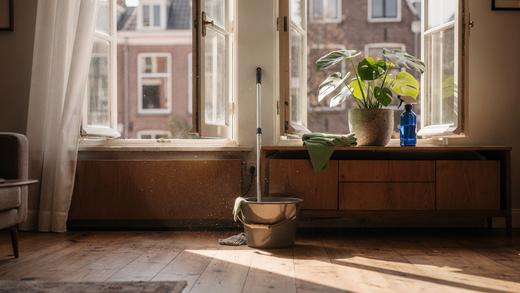
The other half of the residue story is the bucket. A mop that goes back into water that is already grey is not cleaning any more — it is redistributing. You are spreading a thin suspension of everything you have already picked up, plus the soap holding it there, and then leaving it to dry.
The professional habits are not sophisticated:
- Change the water more often than feels necessary. If you can no longer see the bottom of the bucket, it stopped being useful a while ago.
- Two buckets, or a mop with a wringer that separates clean from dirty. This one change improves results more than any product switch.
- Wring properly. A sopping mop leaves a thick layer that cannot evaporate before it dries unevenly — that is where cloudiness comes from.
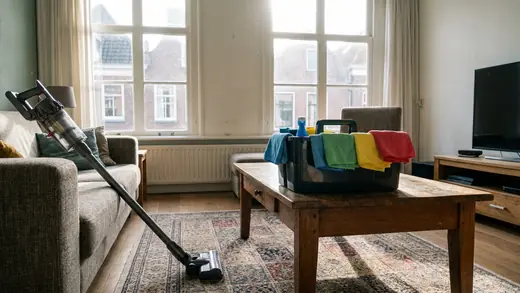
- Vacuum or sweep first, always. Mopping over grit is turning a floor into a grinding paste, and it is how hard floors get dull.
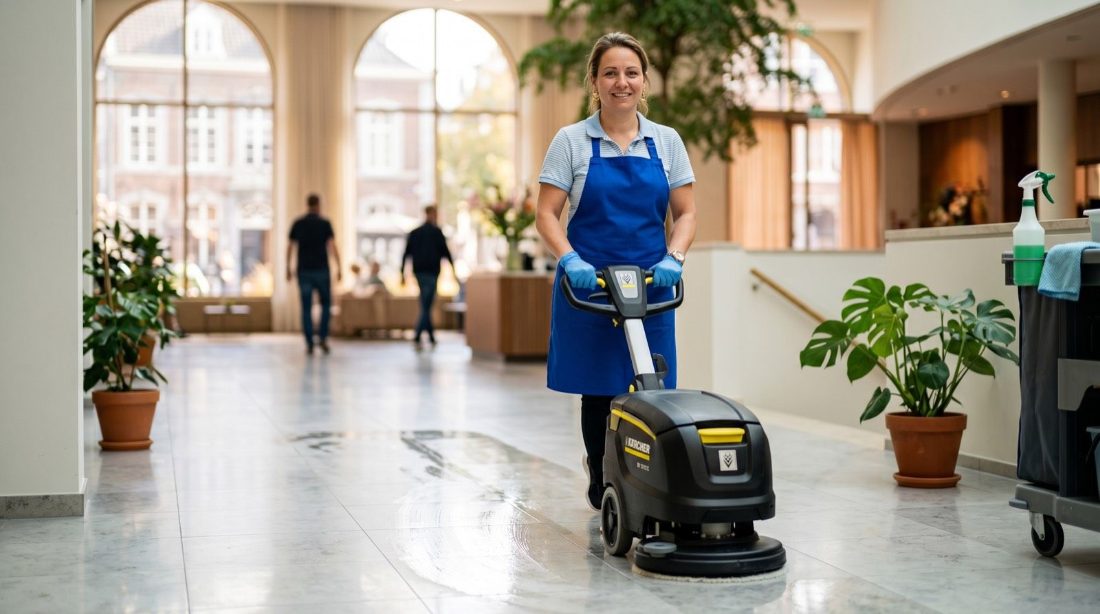
This is also exactly what a scrubber-dryer does in a commercial space: it puts water down, agitates, and then lifts the dirty water back up rather than leaving it to dry. That last step is the whole reason a machine-cleaned floor looks different — nothing is left behind to dry. It is why machine floor work is standard in shops and offices with hard floors and is worth asking about for anything large.
How to reset a floor that has built up
If your floor is already coated, no amount of normal mopping will fix it, because you keep adding to the layer. The reset is simple, boring, and works:
- Vacuum thoroughly, edges included.
- Mop with clean hot water and nothing else. No product at all.
- Change the water. Do it again.
- Repeat until the floor stops feeling tacky when it dries — usually two or three passes, sometimes four on a badly built-up floor.
- Then go back to washing it properly, with the correct dose, and it will stay clean noticeably longer.
On laminate and wood, keep the mop barely damp throughout — standing water is a far more expensive problem than residue. On vinyl and tile you have more latitude.
The same mistake, elsewhere in the house
Once you recognise residue, you start seeing it everywhere.
- Shower screens that stay slightly cloudy: soap film, often on top of limescale, which is why descaling alone sometimes does not fully clear them.
- Towels that stop absorbing. Too much detergent and too much softener coat the fibres. Less of both, and a hot wash, brings them back.
- Windows that dry streaky — nearly always too much product in the water.
- Worktops that feel slightly slick after cleaning, which then attract fingerprints.
The principle is the same everywhere: a cleaning product is a tool for lifting dirt, not a coating to be applied. If it is still there after you have finished, it has stopped helping and started collecting.
Frequently asked questions
Is vinegar a good floor cleaner instead?
It rinses away cleanly, which is its advantage, and it is fine on tile and vinyl. Avoid it on natural stone, where acid etches, and be careful on wood finishes. Warm water and a well-wrung mop does more than people expect.
Do I need to rinse after mopping?
With the correct dose, usually not. If you have been over-dosing, a plain-water pass is the fastest way to stop the cycle. On greasy floors cleaned with a degreaser, yes, rinse.
Why does my floor look worse in sunlight?
Low-angle light reveals film and streaks that overhead light hides. It is not a different floor, it is better evidence — and it usually means residue rather than dirt.
Are steam mops better?
They avoid the residue problem entirely because there is no detergent, and they sanitise. They do not lift heavy grease alone, and they are not for every floor type — check what your flooring manufacturer allows before using one regularly.
My cleaner uses much less product than I did. Is that normal?
It is the most common thing customers notice, and yes. Professional habits are lower dose, cleaner water, changed more often, and the floor swept before it is washed.