

The short answer
- Limescale is mineral, not dirt — it is what the water left behind when it dried.
- Acid dissolves it; abrasion only scratches the surface you are trying to save.
- It comes back because the water here is hard. That is not a failure of cleaning.
- Never use acid on natural stone, and never mix cleaning products together.
- The thirty-second habit that beats it: dry the surface. No water, no deposit.
What’s in this guide
Nothing in a Dutch bathroom is scrubbed harder, more often, or with less effect than limescale. People change products, change cloths, change their whole approach, and the shower screen stays cloudy — and they conclude they are doing it wrong. They are not doing it wrong. They are doing the wrong thing, because almost nobody is told the single fact that makes the whole problem make sense: the white is not dirt. It was never dirt. It is rock, and you cannot wipe rock off glass.
It is not dirt, and that changes everything
Water that comes out of the ground has been through rock, and it arrives carrying dissolved minerals — mostly calcium and magnesium compounds. While the water is water, you cannot see them. When the water evaporates, it leaves them behind on whatever it was sitting on.
That is limescale. The chalky ring in the kettle, the cloudy film on the shower screen, the white crust round the tap and the blocked-looking spray head are all the same event: water dried in place, and the minerals stayed.
You are not looking at something that landed on the glass. You are looking at something the water unloaded onto it.
Once that lands, everything else follows. Dirt sits on top of a surface, so wiping removes it. Limescale IS a layer bonded to the surface, so wiping does nothing at all — you need to dissolve it or you need to break it, and only one of those leaves your bathroom intact.
Why it is worse in Maastricht than where your friends live
Water hardness varies enormously across the Netherlands depending on where the supply comes from, and the south — Limburg included — is at the harder end. It is why a visitor from a soft-water area will look at your shower screen and quietly conclude you do not clean, and why you can move within the country and suddenly discover the kettle stays clear for months.
This is genuinely useful to know for one reason: it stops you blaming yourself, and it stops you buying products to solve a geological problem. Nobody in a hard-water city keeps limescale away permanently. What you can do is make it come back slowly instead of quickly, which is entirely a question of habit rather than product.
Why scrubbing fails, and what it costs
Attack a mineral deposit with abrasion and one of two things happens. Either the deposit is harder than your cloth, in which case nothing comes off; or your cloth is harder than the surface underneath, in which case you take off some scale and also take off some glass, chrome or enamel.
That second outcome is the expensive one, and it is cumulative. Fine scratches are rough, rough surfaces hold water better than smooth ones, and water held in place is precisely how limescale forms. Scour a shower screen for a year and you have manufactured a surface that scales faster than it did when you started.
It is the same reason a scoured stainless sink dulls, and why an old glass screen sometimes never comes properly clear again no matter what you use: the damage is not dirty, it is textured.
What actually removes it
Acid. Limescale is a carbonate, and mild acids dissolve carbonates — which is why the traditional answers are the ones people’s grandparents used and why they still work.
- White vinegar or a citric acid solution for household deposits.
- A proprietary descaler where the deposit is heavy — these are acid too, just formulated to cling.
- Time, not force. This is the part everyone gets wrong: the acid needs to sit on the deposit long enough to work. A spray wiped off after twenty seconds has not dissolved anything.
The professional trick is not a product, it is contact time. On a shower screen: wet the glass, apply, and keep it wet — a paper towel or cloth laid against the glass stops the liquid running off and turns a two-minute job into a job that actually finishes. On a tap or shower head, the equivalent is a bag of solution tied around it.
Then rinse thoroughly, and — this is the bit that matters for next week — dry it.
Where acid will cost you real money
Two warnings, and they are not decoration.
Never use acid on natural stone. Marble, travertine and limestone are carbonates themselves, which means the acid does not know the difference between the scale and your worktop. It will etch the stone permanently — a dull, slightly rough patch that no amount of polishing brings back. Natural stone needs a pH-neutral cleaner made for stone, and if you are unsure what your surface is, assume you are unsure and test somewhere invisible.
Never mix cleaning products. Particularly, never mix anything acidic with bleach. The combination releases a toxic gas, and a bathroom is a small room with a closed door. If you have used one product and want to try another, rinse thoroughly first and open a window.
Be careful too with aged chrome and plated fittings, where the plating may already be thin, and with anodised aluminium. When in doubt: shorter contact, weaker solution, test first.
The thirty-second habit that beats it
Here is the whole prevention strategy, and it costs nothing.
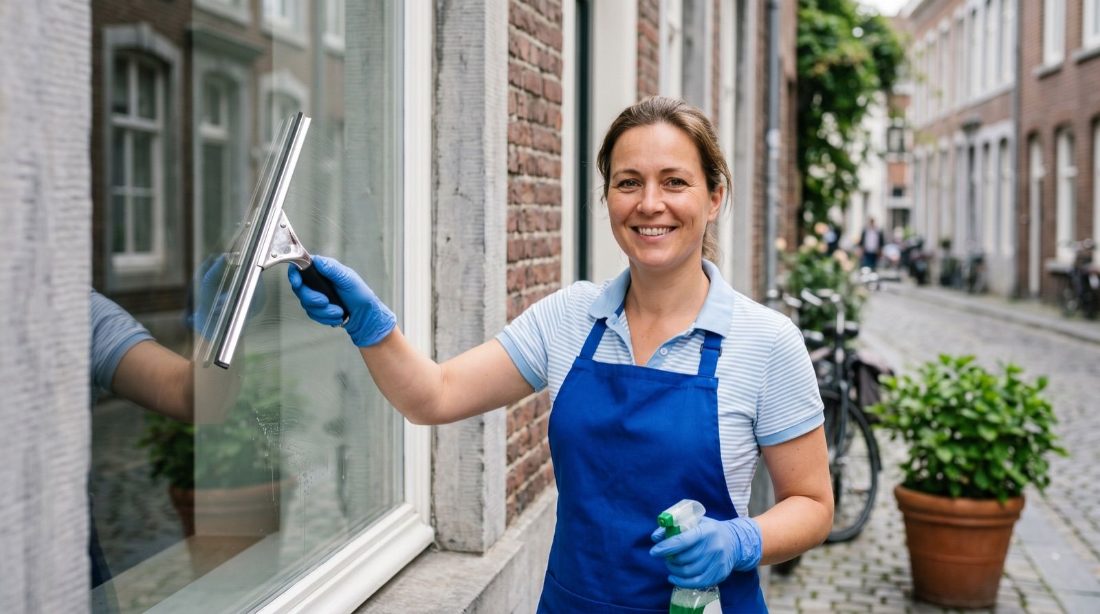
No standing water, no deposit. Limescale forms where water dries. If the water is removed before it dries, there is nothing to leave behind. So: a squeegee down the shower screen after a shower, taking about fifteen seconds; a cloth over the taps and the sink surround after you brush your teeth; the worktop dried rather than left in puddles.
People resist this because it sounds like more cleaning. It is the opposite — it is the only thing in the bathroom that reduces cleaning, because everything else on this page is remedial and this is the one that stops the problem happening. A household that squeegees the screen will never own the thing this article is about.
Heat accelerates it, which is why the kettle and the boiler scale fastest, and why the shower is worse than the basin. Descaling a kettle regularly also keeps it efficient — scale is an insulating layer between the element and the water.
When it is too far gone
Some scale has been there long enough that it has effectively become part of the surface, particularly on older screens that have been scoured for years. At that point the honest answer is that it will improve and not disappear, and that anyone promising otherwise is selling something.
That is one of the jobs where a deep clean earns its keep — not because we know a secret product, but because heavy scale is a job of repeated applications and proper contact time, which is precisely the thing nobody has the patience for on a Sunday. If you would rather do it yourself, the method above is the whole method. Do it twice with an hour in between; that is usually the difference.
Frequently asked questions
Does a water softener solve it?
It addresses the cause rather than the symptom, and households in hard-water areas who install one usually notice the difference in the kettle first. Whether it is worth it depends on your home and your water, and a plumber is a better guide than a cleaning company.
Is vinegar or a shop descaler better?
For everyday deposits vinegar or citric acid works perfectly well. A shop product is usually formulated to cling to vertical surfaces, which is genuinely useful on a shower screen. The difference is contact time, not magic.
Why does my glass still look cloudy after descaling?
Most often it is either remaining scale that needed longer, or it is etching — physical damage from years of abrasive cleaning, which no product can remove because there is nothing to dissolve. If it does not improve at all with acid, it is probably the second.
Can I use a steam cleaner on limescale?
Steam is excellent for grease, grime and hygiene, but scale is a mineral bond and heat alone does not dissolve it. Steam first, acid second, and the combination works better than either.
How often should I descale the shower?
If you squeegee after showers, a proper descale every month or two is plenty. If you do not, expect to be doing it weekly and fighting it every time — which is the whole argument for the squeegee.