




The short answer
- A wet mop on old varnish does not clean the wood — it cleans the film, and swells the seams where the film has gone.
- Anything sold for shine belongs on a table, not on a tread.
- The pale strip down the middle of a tread is worn varnish, not dirt. Scrubbing it harder makes it worse.
- Damp, wrung out, one tread at a time, top to bottom — dry underfoot within a minute or two.
- Dust on the top edge of the skirting and the spindles is what makes a clean stairwell still look grey.
What’s in this guide
- The pale strip on the third tread
- Varnish or oil: find out before you wet it
- Why polish and shine make a staircase dangerous
- Worn tread edges, and what cleaning cannot fix
- Banisters, spindles and the dust nobody sees
- A weekly routine that keeps the stairs safe
- Who is standing on your stairs on Tuesday
- Frequently asked questions
Walk into almost any stairwell in the Jekerkwartier and you will see the same thing: a pale strip down the middle of each tread where two hundred years of shoes have landed, dark corners where nobody walks, and a banister that is glossy for the first metre and furred with dust on top. The strip is not dirt. Knowing that is the difference between a staircase that gets safer every month and one that quietly gets more dangerous.
The pale strip on the third tread
The stairs in these houses were built for people who did not carry a bicycle up them. Narrow treads, a quarter turn at the top, a cast-iron banister bolted to the wall, and on the treads a varnish that has been recoated by somebody in every decade since the war. Each layer sat on top of the last. Together they make a film, and that film is the only thing between a wet shoe and bare pine.
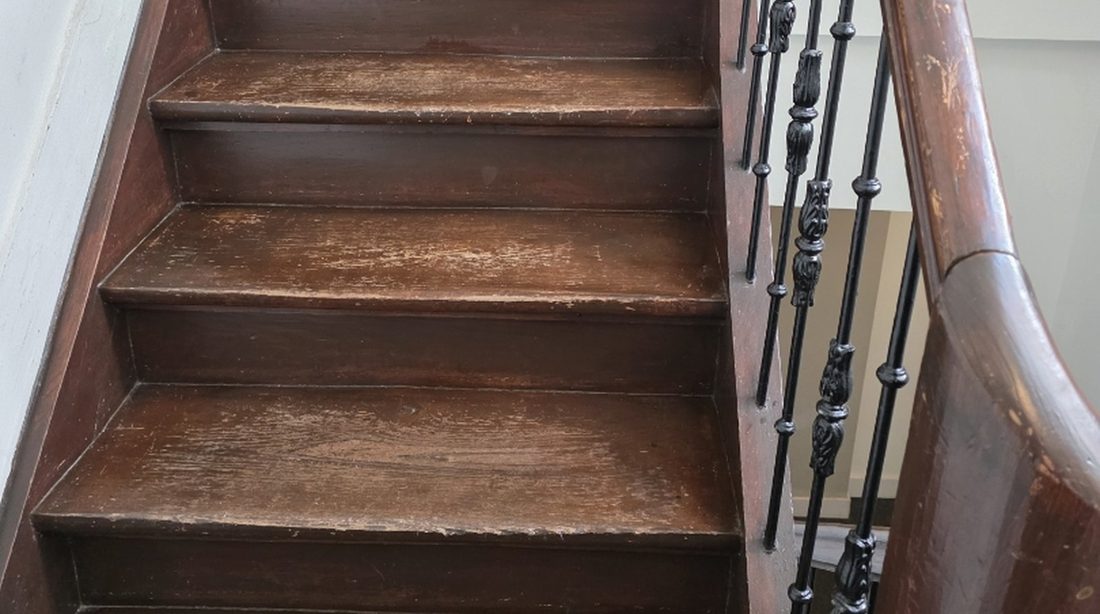
Look at the third tread from the bottom. In the middle there is a strip where the film has gone matte and slightly lighter. At the sides, near the stringer, the varnish is still deep brown and glassy. Everybody who lives in the building walks up the middle, so the middle wore out first, and it will keep wearing out whatever anyone does with a mop.
This matters because the two zones behave completely differently under water. The glassy part sheds it. The worn part drinks it. Pour a bucket over the whole tread and you have just fed water into the one place that cannot take it — and into the joint at the back of the tread, where the nose of the next step meets the riser and the old filler has shrunk away.
Nobody means to do this. It happens because a staircase looks like a floor, and a floor gets mopped.
Varnish or oil: find out before you wet it
Before anybody touches the stairs with a cloth, you want to know what is on the wood. Two families, and they want opposite treatment.
Varnish, lacquer, and the old shellac-and-alcohol finishes sit on top of the timber as a skin. You are never cleaning wood; you are cleaning a plastic or resin film. Neutral cleaner, barely damp cloth, and the film survives. Strong alkaline cleaner, green scouring pad or steam, and the film hazes, then lifts at the edges, and then you have a job that costs a lot more than cleaning.
Oil and wax soak in. They are repaired, not stripped. You clean them with a product that leaves a trace of the same oil behind, and you never let water stand on them, and a strong degreaser pulls the oil straight out and leaves a grey patch that looks like a burn.
The quick test, done on one step in a dark corner: put a single drop of water on the surface and leave it sixty seconds. If it beads and sits there, you have a film — varnish or lacquer. If the edge of the drop goes dark and the wood swells slightly, the film has worn through and the timber is drinking. Then rub one hidden spot with a cloth and a little methylated spirit. If brown colour comes off on the cloth, you are looking at an old shellac finish, and that staircase wants almost no moisture at all.
One thing plainly: steam is not for these stairs. Steam is excellent on tiles in an entrance hall and on a grouted floor. On a hundred-year-old varnished pine tread it drives moisture through the worn strip, lifts the film in sheets and blooms the surface white. We say that to people who ask for steam cleaning in a stairwell, and then we do the treads by hand instead.
Why polish and shine make a staircase dangerous
Here is the part that should worry a board or a landlord more than dirt does.
A worn tread with clean, matte varnish has grip. A tread that has been treated with a spray polish, a shine restorer, a wax-in-water product or one of those milky "wood nourishers" has a soft, slick layer on it. Under a dry sock it feels wonderful. Under a wet shoe on a January morning in Wyck, when everyone comes in from the Maas with rain on their soles, it is a slide.
Worse, the polish builds. Each application leaves a little more, and the build is thickest exactly where nobody walks — near the stringers and in the corners — while the middle stays bare. So you get a tread where the outer edges are slippery and the centre is not, which is precisely the wrong way round for somebody who grabs the banister and steps wide.
The rule we work to in a shared stairwell is simple: nothing that shines. No polish, no wax on treads, no oil soap on a varnished finish, no all-purpose cleaner poured in strong "because the stairs are filthy". Neutral cleaner, correctly diluted, wrung out hard. The stairs come up clean and honest-looking, which is what you want. If a board wants the gloss back, that is a sanding-and-recoating job for a floor finisher, not something a cleaner should fake with a bottle.
Anti-slip, if you need it, is mechanical: a strip on the nose of each tread, or a runner properly fixed down. Not chemical.
Worn tread edges, and what cleaning cannot fix
The nose of the tread — the rounded front edge — takes the whole weight of every step down. In an old building you often find the varnish gone entirely along that edge, the pine rounded off and slightly furry, and sometimes a split running with the grain where a nail has worked loose. Two or three treads in, there is a creak that changes note depending on which side you stand.
None of that is a cleaning problem, and we will say so rather than scrub at it. What cleaning does is keep grit off the nose, because grit is an abrasive and every shoe grinds it into the remaining varnish; and it keeps you honest about what you are looking at, because a clean staircase is the only one you can actually inspect. A loose nose, a spindle that moves in its socket, a banister bracket whose screws have pulled out of the plaster — those go on a note to the board, with a photograph, the same week we see them.
Owners' associations and landlords in these buildings carry a general duty to keep the shared parts of a building in a safe, usable state, and a stairwell is the part of that with the sharpest consequences. That is the broad shape of the position, not legal advice and not something to act on from a cleaner's blog: for rent and deposit questions the Huurcommissie is the body that decides, and for anything else het Juridisch Loket will point you in the right direction. What we can tell you is what a stairwell looks like when it has been cleaned round a problem for two years instead of having it fixed.
Banisters, spindles and the dust nobody sees
Everybody cleans the handrail where hands go. The dust lives everywhere else.
On top of each spindle there is a small flat where the turning steps down, and that flat collects a grey felt of house dust, wool from coats and hair. The top edge of the skirting that runs up beside the stairs collects the same. So does the underside of the handrail, which nobody ever wipes, and the corner where the tread meets the riser, where a dry brush finds more than a vacuum does because the vacuum nozzle cannot reach into a right angle.
The order matters, and it is the one thing most people get backwards. Dust down before you clean the treads — banister, spindles, skirting, window ledge on the landing, the light fitting if it is reachable — because all of that lands on the steps. Then vacuum, with the brush on and the hose worked into the back corner of every tread. Then, and only then, damp-wipe the treads, top to bottom, so you never walk back over what you have just done.
Cast iron is its own small thing. A damp cloth and a dry cloth straight after; iron that is left wet in a cold stairwell blooms rust at the joints and stains the plaster below it in a brown tear-shape that everyone thinks is a leak.
A weekly routine that keeps the stairs safe
Written for one stairwell of four or five floors, once a week, with a second dry pass mid-week in winter when the salt and grit come in from the street.
- Prop the street door or the letterbox lobby open. These halls have no airflow, and the treads need to dry in minutes, not hours.
- Dust from the top landing down: handrail top and underside, every spindle including the flat on top, skirting edges, the ledge under the landing window.
- Vacuum every tread with the brush head, into the back corner and along the nose, and lift the mat at the bottom rather than vacuuming around it. The grit under that mat is what wears the hall floor.
- One bucket, neutral cleaner, correctly diluted. A flat cloth or a small flat mop head, wrung until it is barely cool to the hand. One tread at a time, along the grain, riser included, top to bottom.
- Change the water when it goes grey. Grey water is grit in suspension, and you are now sanding the varnish with it.
- Check as you go down: anything loose, anything split, a bulb out on the second landing, a pram chained to the banister. Those are safety items, not housekeeping items, and they belong in the note to whoever manages the building.
Treads should be dry underfoot before you reach the front door. If they are not, the cloth was too wet — and a stairwell that stays damp for half an hour is a stairwell where somebody will come down in socks.
Who is standing on your stairs on Tuesday
A shared stairwell is the one space in a building where nobody is at home and everybody is responsible, which is why it is also the space where cleaning quietly stops happening and nobody can say when. That is the doubt worth removing, and we removed it with a tag and a camera rather than a promise.
There is an NFC tag on the wall of the stairwell. Whoever cleans it checks in on that tag when they arrive, so the visit exists as a fact and not as an invoice line. The work is photographed — treads, corners, spindles, the landing — and before the job is closed those photos are reviewed by AI against the checklist for your building, so a skipped top landing gets caught by us and not by a resident on the stairs. We are insured and registered with the Dutch Chamber of Commerce, we work in English as well as Dutch for the mixed buildings around the university, and the rating on Google is 5.0. For a board, the practical value of all that is one thing: at the end of the month you can see what was done, on which day, on which floor.
The same approach runs through our staircase cleaning in Maastricht and the rest of Limburg, and through the business cleaning in the offices and practices that sit behind these same front doors.
I clean and manage stairwells in old Maastricht buildings; if you look after a building in the Jekerkwartier or Wyck and the treads have started to worry you, send us the address and a photo of the worst step through the free estimate form and we will tell you what the staircase actually needs.
Frequently asked questions
How do I know whether my stairs are varnished or oiled?
Put one drop of water on a hidden step and wait a minute. If it beads and sits there, there is a film on top — varnish or lacquer. If the edge darkens and the wood swells slightly, the film has worn through. Rub a hidden spot with methylated spirit too: if brown colour comes off on the cloth, it is an old shellac finish and it wants almost no moisture.
Can I use a steam cleaner on an old wooden staircase?
No. Steam pushes moisture through the worn strip in the middle of each tread and into the joints, and it can lift or cloud old varnish. Steam is for tiled halls and grouted floors. Treads in these buildings are done by hand, damp and wrung out.
What makes wooden stairs slippery after cleaning?
Almost always a product that was meant to add shine: spray polish, a wax-in-water cleaner, a wood nourisher, or oil soap used on a varnished finish. It builds up where nobody walks, so the edges of the tread end up slicker than the middle. Use a neutral cleaner and accept a matte finish — grip matters more than gloss in a shared stairwell.
The front edges of our treads are worn through. Will cleaning help?
Cleaning keeps grit off them, which slows the wear, but bare, furry, split tread noses are a repair job for a floor finisher or carpenter. What we do is keep the grit off, photograph the spots that are getting worse, and tell the board plainly rather than scrubbing at them.
How often should a shared stairwell in an old building be cleaned?
Once a week suits most buildings of four or five floors, with an extra dry pass mid-week in winter when grit and salt come in from the street. Buildings with student flats, an Airbnb or a practice at street level see far more traffic and usually need more.
Do you work in English?
Yes. The team works in English as well as Dutch, which tends to matter in buildings where the owners, the tenants and the board do not all share one language.