


The short answer
- Mould is a moisture problem. It grows where there is water, not where there is dirt.
- Condensation is seasonal, spreads as speckles on cold surfaces, and is worst in corners and behind furniture.
- A leak is a defined patch, often with a brown or yellow edge, and does not care about the season.
- Cleaning removes what is visible; it does not remove the reason. Fix the water or it returns.
- Report anything you think is a leak to a landlord in writing, immediately — an unreported leak becomes your problem.
What’s in this guide
Black speckles in the corner of a window reveal. A grey bloom behind the wardrobe on the outside wall. A brown-edged patch on a bedroom ceiling. People call all three "mould" and try to clean all three the same way, and then feel defeated when it comes back within a month. It comes back because two of those are a moisture problem and one is a building problem, and cleaning is not the solution to either — although it is a necessary part of one of them. Telling them apart takes one evening and no equipment.
It is not a cleaning failure
The first thing worth saying plainly, because people are quietly ashamed about this: mould in a flat is not evidence that you do not clean. Mould needs moisture, a surface and a temperature, and it will grow perfectly happily on a spotless wall if those three are present. Households who clean twice as hard get exactly the same result, because scrubbing addresses the growth and not the water.
Mould is a symptom. It tells you where water is, and how long it has been there.
Which means the useful question is never "how do I clean this?" It is "where is the water coming from?" — and there are only two answers.
How to tell the two apart
You are looking for a pattern, not a colour. Four questions usually settle it in an evening.
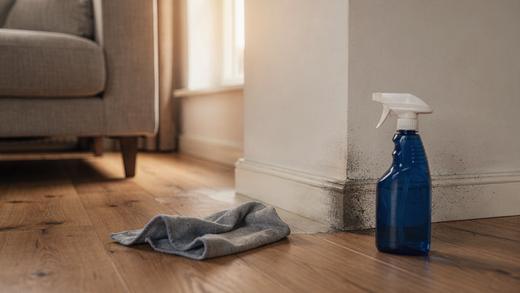
- Where exactly is it? Condensation collects on the coldest surfaces: window reveals, the corner where two outside walls meet, behind furniture pushed against an external wall, and along the top of skirting boards on cold walls. A leak appears where the water arrives — often mid-ceiling, around a pipe, under a window that is letting in rain, or on the wall shared with a bathroom.
- What shape is it? Condensation is speckled and diffuse — hundreds of small dots fading out at the edges. A leak is a patch with an edge, often with tidemarks or a brown or yellow ring, because the water carried something with it.
- Does the season change it? Condensation is a winter problem, worse when the heating is on and the windows are shut. A leak does not care what month it is.
- Does it come back in exactly the same place? Both do — but a leak comes back in the same shape, and condensation comes back wherever the room is coldest that year.
The condensation pattern
Warm air holds moisture; cold air does not. Household air is full of water — cooking, showering, drying laundry indoors, and simply breathing all add to it — and when that warm wet air meets a cold surface, it gives the water up. That is the fog on the bathroom mirror, and it is also the invisible version happening on the wall behind your wardrobe.
Dutch flats are good at producing it, particularly ones that have been insulated and sealed for warmth without a matching improvement in ventilation. What was draughty was also self-ventilating; what is airtight needs a plan.
What actually reduces it:
- Ventilate on purpose. Windows at both ends of the home, ten minutes, twice a day. A cross-draught changes the air; a tilted window mostly does not. It costs less heat than people fear, because you are changing the air, not cooling the walls.
- Extract at the source. Run the bathroom fan during a shower and for a while afterwards, with the door closed. Use the cooker hood, and use the lid on pans.
- Dry laundry outside or in a vented tumble dryer if you possibly can. A full load of wet washing dried on a rack releases litres of water into a flat.
- Let air move behind furniture. A few centimetres between a wardrobe and an external wall is often the entire fix for that specific patch.
- Keep the heating steady rather than in bursts. Cold surfaces are the condensing surfaces, and a room that swings between warm and cold produces the most.
The leak pattern
A leak is a building fault and it does not stop on its own. If the patch has an edge, a stain, or is growing while the weather is dry, treat it as one — and treat it with some urgency, because water in a structure does far more expensive damage than it does on a surface.
Common origins in a Dutch flat: a failed seal around a window or a balcony door, a roof or gutter problem, a pipe in a wall or under a floor, a shower tray or the sealant around it, and the flat upstairs — which is the one nobody wants to raise and the one most often responsible.
If you rent: report it in writing today, with photographs and the date. This is not about being difficult. An unreported leak that damages a property over months starts to look like neglect, and that shifts the conversation about who pays. A reported one is the landlord’s problem from the day you sent the message, which is exactly where it should be. See what a landlord may hold back from your deposit for why that distinction matters so much.
What to do this week
- Photograph it, with something for scale, and note the date.
- Check the four questions above and decide which pattern you have.
- If it looks like a leak, report it in writing now, even if you are not certain.
- If it looks like condensation, start the ventilation routine and move the furniture off the wall. Give it a fortnight before you judge.
- Clean the visible growth — with sensible precautions. Ventilate the room, wear gloves, and do not dry-brush it, which sends spores into the air.
- Then watch the same spot. If it returns quickly, the water is still arriving and no amount of cleaning is the answer.
What cleaning can and cannot do
Cleaning removes the growth from the surface. Done properly, on a hard non-porous surface like tile, glass or painted plaster in good condition, that is a real and durable result — and it is a normal part of a thorough deep clean, particularly in bathrooms and behind furniture on cold walls.
What cleaning cannot do is make a wall dry. If the water keeps arriving, the growth returns, and the only thing that has changed is that you are tired. Equally, where mould has gone into porous material — silicone sealant, plasterboard, wallpaper backing, the inside of a sofa — the answer is replacement rather than cleaning, because there is nothing to clean from the surface of something that is colonised through its thickness.
And where a patch is large, or where anyone in the home has asthma or a respiratory condition, stop and get advice rather than attacking it yourself. That is not us being cautious about our own trade: it is that air quality is a health matter, and a bad afternoon with a bucket can make a room worse for a week.
Frequently asked questions
Is bleach the right thing to use on mould?
On hard, non-porous surfaces it addresses the visible growth. On porous ones it mostly bleaches the colour out while leaving what is underneath, which is why it "comes back" so fast. Ventilate well, wear gloves, and never mix it with anything acidic.
Why is it always behind the wardrobe?
Because that is the coldest, stillest surface in the room: an external wall with no air moving over it. Pull furniture a few centimetres off external walls and that specific patch usually stops.
Does a dehumidifier fix it?
It reduces humidity, which genuinely helps with condensation, and it does nothing at all for a leak. Treat it as support for ventilation rather than a substitute for finding the cause.
My landlord says it is my lifestyle. Is that true?
Sometimes partly, and sometimes it is a building that cannot cope with ordinary living. Both can be true at once. Document the pattern, do the ventilation properly so it is not in question, and if you cannot agree, the Huurcommissie is the place that settles it.
Can you clean mould as part of a normal visit?
Surface growth on hard surfaces, yes, as part of a deep clean. What we will not do is paint over a problem — if it looks like water is still arriving, we will tell you that rather than clean it and let you discover it again next month.