

The short answer
- Hiring a cleaner privately is legal in the Netherlands under the Regeling dienstverlening aan huis.
- It also makes you an employer: minimum wage, 8% holiday allowance, paid leave and up to 6 weeks’ sick pay.
- You owe a safe workplace. If someone is hurt in your home, that is your exposure, not theirs.
- Through a company, continuity, insurance, equipment and cover are inside the price.
- The honest comparison is not rate versus rate — it is what each rate already includes.
What’s in this guide
- What you are actually choosing between
- The rule that makes private hiring legal
- What being an employer quietly means
- “But we never signed anything”
- What it costs when it goes wrong
- Who is covered when something goes wrong
- Illness, holidays and the week it does not happen
- What the private rate really costs
- Which one actually fits you
- Frequently asked questions
Most people looking for a cleaner in Maastricht compare an hourly rate and stop there. That is a fair instinct and it hides the real decision, because the two options are not the same product at a different price — they are two different arrangements, with the risk sitting in different places. Hiring someone privately is entirely legal here; the Netherlands has a rule designed to make it so. What that rule does not do is remove the obligations that come with it, and those are the part almost nobody is told about.
What you are actually choosing between
There is a real choice here and it is not obvious. On one side: you find someone, agree an hourly rate, and they come on Tuesdays. Simple, personal, usually cheaper on paper, and for a great many households it works perfectly well for years. On the other: a company sends someone, and the rate carries a set of things you never handle yourself.
What follows is not an argument that one is right. It is what each one contains, so the comparison is a real one. It says plainly where the private route is the better answer.
The rule that makes private hiring legal
The Netherlands has a specific arrangement for this: the Regeling dienstverlening aan huis, introduced in 2007 to bring domestic work above board rather than to push it underground. In outline, it applies when a private individual hires another private individual for household work in or around the home for fewer than four days a week.
Under it, you do not have to withhold payroll tax or social insurance contributions for that person. This is the part everybody knows, and it is genuinely a simplification. It is also the only part most households are ever told.

ℹ This is general information, not legal advice
We are a cleaning company, not an adviser. The outline here follows the Dutch government’s own published guidance on the Regeling dienstverlening aan huis; for your own situation, Rijksoverheid is the authority, and anything unusual is worth putting to someone qualified.
What being an employer quietly means
The exemption is from withholding, not from being an employer. Under the same rule, the household is expected to:
- pay at least the statutory minimum wage;
- pay 8% holiday allowance on top;
- give paid holiday — four times the weekly hours, each year;
- continue paying wages during illness, for up to six weeks;
- provide a safe and healthy place to work.
The two holiday entries are different things, and mixing them up is the commonest mistake here. Holiday allowance is money — 8% on top of everything you pay. Paid holiday is time — four weeks a year, still paid. You owe both, not one or the other.
The time is always four weeks; only the hours change with yours. Find your own row:
| If they come | Paid holiday you owe a year |
|---|---|
| 2 hours a week | 8 paid hours |
| 3 hours a week | 12 paid hours |
| 4 hours a week | 16 paid hours |
| 6 hours a week | 24 paid hours |
| 8 hours a week | 32 paid hours |
The 8% holiday allowance sits on top of every one of those rows, on everything paid across the year.
That is the floor, not the ceiling: you are free to agree more holiday, never less.
Read that list again with an ordinary arrangement in mind — someone who comes three hours a week, cash or bank transfer, no paperwork. Most such arrangements do not include holiday allowance or sick pay, because neither side knew they were part of it. That is not dishonesty on anyone’s part. It is simply not widely known.
It matters because the obligation does not disappear by being unmentioned.
“But we never signed anything”
This is the sentence almost everyone reaches for, and it is the one that helps least. In the Netherlands an employment contract exists the moment three things are true at once: someone does work, they are paid for it, and they work under your direction. Nothing has to be signed. Nothing has to be printed. “Come on Tuesdays, this is the hourly rate” is already a valid arbeidsovereenkomst.
So there is no such thing as having a cleaner and having no contract. There is only having one you never wrote down.
What the missing paperwork changes is not the obligations — those are set by law and arrive whether or not anyone mentions them. It changes who can prove what, and it removes protections that only exist on paper:
- Nothing agreed about duration means it is open-ended. You do not have a casual arrangement. You have an indefinite one.
- Some terms are valid only in writing. A probation period, a penalty clause, a notice clause — if it was never written, you simply do not have it.
- In a disagreement, the question is what can be shown. Statutory minimums are the floor and they need no proof at all; anything you believe you agreed above or below them does.
What it costs when it goes wrong
Almost all of these arrangements end quietly and well. The ones that do not tend to end at the worst moment — someone falls ill, someone is let go, someone finally looks up what they were owed — and the bill is not for last month. It reaches backwards.
| What can be claimed | How far back |
|---|---|
| Unpaid wages, and the gap if the rate was under minimum wage | Up to 5 years |
| The 8% holiday allowance, if it was never paid | Up to 5 years |
| Paid holiday never taken or paid out | Around 3 years |
| Wages during illness, up to six weeks | Per occasion |
| Transition compensation on ending the job | From the first working day |
Two of those surprise people. The first is the five-year reach: an unpaid holiday allowance is not a small annual oversight, it is 8% of everything you have paid that person for as long as five years, claimable in one go. The second is transition compensation — as of 1 January 2020 it is owed from the first working day rather than after two years, at a third of a month’s pay for each year worked. Four years of Tuesdays is well over a month’s pay, due when the arrangement ends.
There is a third, and unlike the other two it does not wait for the arrangement to end.
Wages are due at the end of the agreed pay period, and that period can never be longer than a month. Pay later and the law adds a penalty on top of the wages. It builds quickly over the first fortnight and can reach half the amount owed.
This is the one that catches decent households, because the informal arrangement invites it: cash next time you see each other, settling up when you are back from holiday, a fortnight running on because neither of you minded. Nobody involved thinks of it as late wages. The law does.
⚠ Ending it is easier here than in a normal job — but it is not nothing
Under this rule a private household does not need permission from UWV to end the arrangement, which is a genuine simplification. It still needs a notice period and a real reason, and it cannot be done while the person is ill. Rijksoverheid publishes the current notice periods; we are not going to put a number on it here, because that is exactly the kind of detail worth reading from the source rather than from a cleaning company.
None of this is a reason to be frightened of hiring someone privately. It is a reason to spend twenty minutes writing down what you agreed — which costs nothing, protects the person doing the work exactly as much as it protects you, and removes almost every dispute before it can start.
Who is covered when something goes wrong
Two exposures sit on the household in a private arrangement, and both are easy to overlook until the day they are not.
If the person working in your home is injured. The duty to provide a safe workplace is yours. A fall from a chair used as a step, a slip on a wet floor, a back injury lifting furniture — these happen in ordinary houses. Under this route the worker is not insured through you for sickness, disability or unemployment. They can arrange voluntary cover with UWV, but many do not, and the question of who bears the cost then lands between you.
If something of yours is damaged. A private individual generally carries no liability cover for work in someone else’s home. If a vacuum takes a chip out of a skirting board, or the wrong product marks a stone worktop, there is no policy behind it — only a conversation between two people who probably like each other, which is precisely why it is an uncomfortable one.
Through a company both of these are somebody else’s problem by design. We are insured for liability and registered with the Chamber of Commerce (KvK 86396862); if we damage something, that is ours to put right, and nobody has to have an awkward conversation about it.
Illness, holidays and the week it does not happen
This is the difference households notice first in practice, long before any of the legal points come up.
One person is one person. When they are ill, on holiday, moving house or simply have a difficult month, the cleaning does not happen — and you owe pay for the sick weeks regardless. Over a year that is typically several missed visits, usually clustered at the least convenient moment.
A company covers the visit. That is most of what the difference in rate is buying, and it is the reason offices, holiday lets and anyone with a fixed handover use companies almost without exception: an Airbnb changeover cannot be postponed a week because one person has flu.
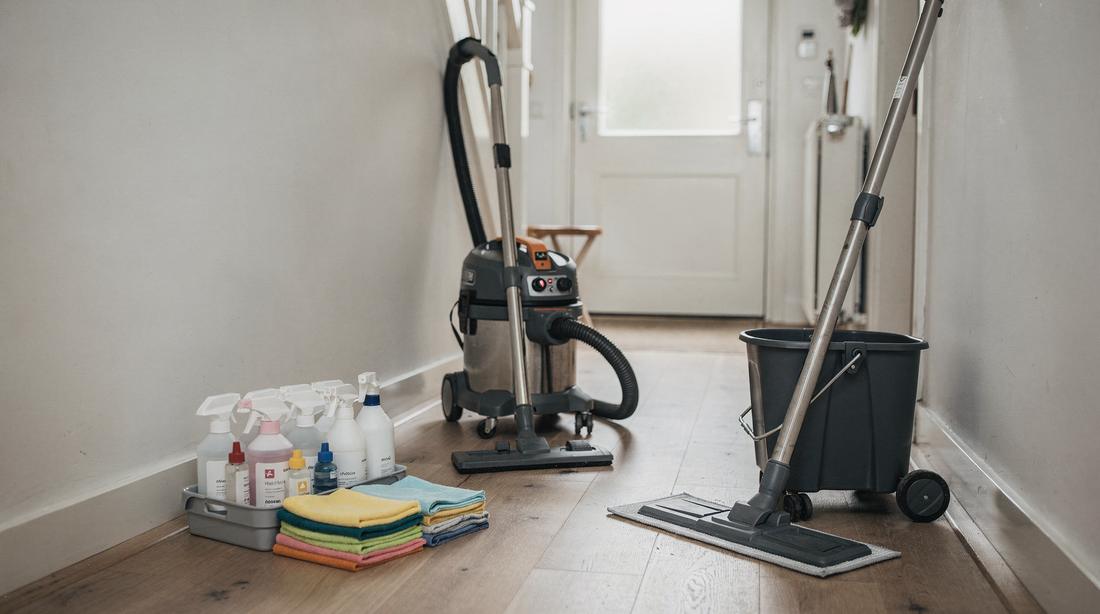
There is also the quiet question of equipment and products — and they are two different questions, which is worth being precise about because plenty of companies are not.
Products and equipment follow one rule. On a one-time job — a deep clean, a move-out, after a party — we always bring both, included in the price. On a cleaning plan it is your choice: use your own products and vacuum, or ask us to bring ours by arrangement. For businesses it is optional and set in the quote. Allergies or delicate surfaces, tell us and we use what you prefer.
In a private arrangement there is no such choice. The vacuum, the mop, the products and replacing all of it are the household’s, permanently.
What the private rate really costs
Whatever rate you agree, it is not what the cleaning costs you.
Four of the fifty-two weeks are paid holiday, so you pay for fifty-two and the cleaning happens in forty-eight. Add the 8% holiday allowance on the year. Together that is roughly a sixth more per hour than the figure you shook hands on — before anyone is ill.
And that is the floor. It assumes everything paid correctly, in a year where nobody is hurt, nothing breaks and the arrangement never ends. It does not cover the vacuum, the products, replacing them, or the evenings spent finding someone new when they move away.
The hourly comparison hides the real difference: you are not buying cleaning, you are taking on an employee — the holiday, the sick weeks, the paperwork, the liability, all of it. Which is better value depends on whether you wanted that.
Line by line:
| What | Private arrangement | Through a company |
|---|---|---|
| Holiday allowance (8%) | Yours to pay | In the rate |
| Paid holiday | Yours to pay | In the rate |
| Sick pay (up to 6 weeks) | Yours to pay | In the rate |
| Cover when they are away | None | In the rate |
| Liability if something breaks | Effectively yours | Insured |
| Vacuum, mop and everyday kit | Yours, permanently | Your choice on a plan, ours on a one-off |
| Professional machines for a deep clean | Not realistic | Ours, included |
| Cleaning products | Yours | Yours on a plan, ours on a one-off |
| Finding and replacing someone | Yours | In the rate |
| Invoice with VAT | No | Yes |
For a business the question does not arise: a business needs the VAT invoice and cannot use this rule at all. The Regeling is for private households only.
What drives cleaning prices in this city generally — private or otherwise — is a separate article.
Which one actually fits you
Hiring privately is the better answer when you have found someone you trust and want a long personal relationship; your hours are small and regular; you are relaxed about occasional missed weeks; and you are willing to set the arrangement up properly — written agreement, holiday allowance, paid leave, sick pay. Done that way it is a good arrangement and a fair one. Many households in Maastricht run it happily for years.
A company fits better when the visit genuinely has to happen — a rental changeover, an office, a handover date; when you would rather not be an employer; when you want the work checked rather than assumed; or when you simply do not want to manage it. Ours is checked in on site with an NFC tag and every finished area is photographed and reviewed before the job is called done, which exists so that "was it actually cleaned properly?" has an answer that is not a matter of opinion. Details on home cleaning and how we work.
★ Whichever route you choose, write it down
Hours, rate, what is included, what happens on holidays and sick days, and who supplies the products. One page. It protects the person doing the work exactly as much as it protects you, and it removes almost every argument that domestic cleaning arrangements actually end on.
Frequently asked questions
Is it legal to hire a cleaner privately in the Netherlands?
Yes. The Regeling dienstverlening aan huis, introduced in 2007, exists specifically to allow it. It applies when a private individual hires another private individual for household work in or around the home for fewer than four days a week, and it removes the obligation to withhold payroll tax and social insurance contributions. It does not remove the obligations that come with being an employer.
Do I have to pay a private cleaner when they are ill or on holiday?
Under the Dutch rule, yes. The household is expected to pay at least the statutory minimum wage, add 8% holiday allowance, give paid leave of four times the weekly hours each year, and continue paying wages during illness for up to six weeks. Most informal arrangements do not include these, usually because neither side was aware of them.
Do I need a written contract for a cleaner, or is a verbal agreement enough?
A verbal agreement is already a valid employment contract in the Netherlands. One exists the moment someone does work, is paid for it, and works under your direction — nothing has to be signed. So there is no such thing as having a cleaner and having no contract, only having one you never wrote down. Writing it down does not create the obligations; it records what was agreed, and some terms such as a probation period are valid only if they are in writing.
What can a cleaner claim if things go wrong and nothing was ever written down?
Wage claims, including the gap if the rate was below minimum wage and the 8% holiday allowance if it was never paid, can reach back up to five years. Paid holiday never taken or paid out reaches back around three years. Wages during illness apply per occasion, up to six weeks. And transition compensation is owed when the job ends — as of 1 January 2020, from the first working day rather than after two years, at a third of a month’s pay per year worked.
Can I just stop having a private cleaner come?
Not without notice. Under the Regeling dienstverlening aan huis a private household does not need permission from UWV, which is genuinely simpler than a normal job, but a notice period still applies, there has to be a real reason, and you cannot end it while the person is ill. Transition compensation may also be due. Rijksoverheid publishes the current notice periods and is the place to check them for your own situation.
Who is liable if a cleaner is injured in my home?
Providing a safe and healthy place to work is the household’s responsibility under the same rule, so in a private arrangement that exposure sits with you. The person working is not insured through you for sickness or disability — they can arrange voluntary cover with UWV, but many have not. Through a company, the company carries liability insurance and the risk is theirs.
Is a cleaning company more expensive than hiring privately?
Per hour, yes. But an agreed hourly rate is not what the cleaning costs: four of the fifty-two weeks are paid holiday, and 8% holiday allowance is due on the year, so an hour actually cleaned works out roughly a sixth more than the figure agreed — and more again after a sick week. The larger difference is not price at all. Hiring privately means taking on an employee, with the holiday, the sick weeks, the liability and the paperwork that come with that.
Can a business hire a cleaner under the Regeling dienstverlening aan huis?
No. The arrangement is for private individuals hiring other private individuals for household work in and around the home. A company, practice, shop or office needs a proper commercial arrangement with a VAT invoice, which is a different route entirely.