

The short answer
- A hard floor is a surface; upholstery is a reservoir that fills and releases.
- Every time somebody sits down, a cushion exhales a cloud of what is inside it.
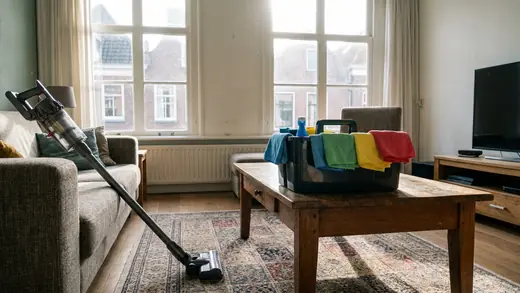
- Five minutes with the upholstery tool, monthly, does more for a room than another floor pass.
- Vacuuming reaches the top layer only — extraction cleaning reaches what is deeper.
- The mattress is the same story, and it is the one you breathe against for eight hours a night.
What’s in this guide
Everybody vacuums the floor. Almost nobody vacuums the sofa — and if they do, they do the seat and stop. Meanwhile the floor is a flat, hard surface that holds nothing and gives up everything to a vacuum in one pass, while the sofa is several hundred litres of open fibre that has been quietly filling up since you bought it. If you want a single change that makes a living room measurably less dusty, it is not the floor. It is the thing you are sitting on while you read this.
A reservoir, not a surface
Think about what a vacuum actually does on a hard floor: the dust is lying on top, there is nowhere for it to hide, and one pass takes essentially all of it. The floor is a surface, and surfaces are easy.
Upholstery is not a surface. It is a deep, open structure of fibres and foam with air moving through it, and dust that lands on it does not stay on top — it works down between the fibres, helped along by every person who sits down. There it stays, because nothing in a normal week removes it.
A floor collects dust. A sofa stores it, and then hands some back every time you sit down.
That is the mechanism people find surprising: a cushion is a bellows. Sit down and air is forced out through the fabric, carrying fine particles with it. Stand up and air is drawn back in, bringing new dust with it. A well-used sofa is running that cycle a dozen times a day.
Why everybody skips it
Three reasons, and none of them is laziness.
It does not look dirty. Fabric hides dust extremely well — especially textured or patterned fabric, which is chosen precisely for that quality. A floor shows you when it needs doing; a sofa never does until something is spilled on it.
It is not in the routine. Cleaning routines are built around rooms and floors, and furniture gets treated as an obstacle to be worked around rather than an item to be cleaned.
The tool is in a drawer. Almost every vacuum comes with an upholstery tool. Almost nobody has used theirs, because swapping attachments costs thirty seconds and there is never a moment when that feels worth it.
A test you can do today
You do not have to take any of this on trust. Two minutes:
- Take the cushions off the sofa.
- Look at what is in the base — not the crumbs and the coins, the grey felt-like layer in the corners and along the seams.
- Now put the upholstery tool on the vacuum and do one cushion, both sides, and the seam it sits in.
- Open the vacuum.
People who do this once tend not to need convincing again. The contents of one cushion seam are usually more than a week of floor.
The five-minute routine
Monthly is enough to change the character of a room. The order matters slightly, because everything falls downward.
- Cushions off, both sides done, including the underside that never sees daylight.
- The base, right into the corners where the arms meet the back.
- The seams and piping, with the crevice tool. This is where the majority of it is.
- The back and the arms, which collect skin oils and hair rather than grit.
- Underneath the sofa, and behind it, where there is no airflow at all.
- Then the floor, because you have just dislodged a fortnight of dust onto it.
If the cushion covers come off and the label allows it, washing them once or twice a year does more than any spray. And if you have a pet, halve every interval in this section — animal hair weaves into fabric rather than resting on it, which is why a rubber glove or a stiff brush pulls out what a vacuum leaves behind.
The other reservoirs in the room
Once you have seen it in the sofa, the rest of the room is easy to name. Every soft thing is doing the same job.
- Curtains. Full-length ones hang in the exact path of air coming through a window and act as a filter that is never changed. Most can be washed or at least shaken out and vacuumed; almost none are.
- Rugs, and particularly the floor under them. A rug that is never lifted is a lid.
- Cushions, throws and dog beds, which are washable and which people wash far less often than they think.
- Upholstered dining chairs, which are sat on in outdoor clothes and never once vacuumed.
You do not need to do all of it. The point is only that a room’s dust budget is set by its soft surfaces, so if a room feels dusty no matter how often you clean the floor, the answer is somewhere in this list.
When vacuuming is not enough
Vacuuming reaches the top layer. It does not reach what is bonded to the fibres deeper down — the fine dust held by static, the body oils, the residue of years of sitting — and that is what makes an older sofa look tired even when it is clean and what makes a room smell faintly of itself.
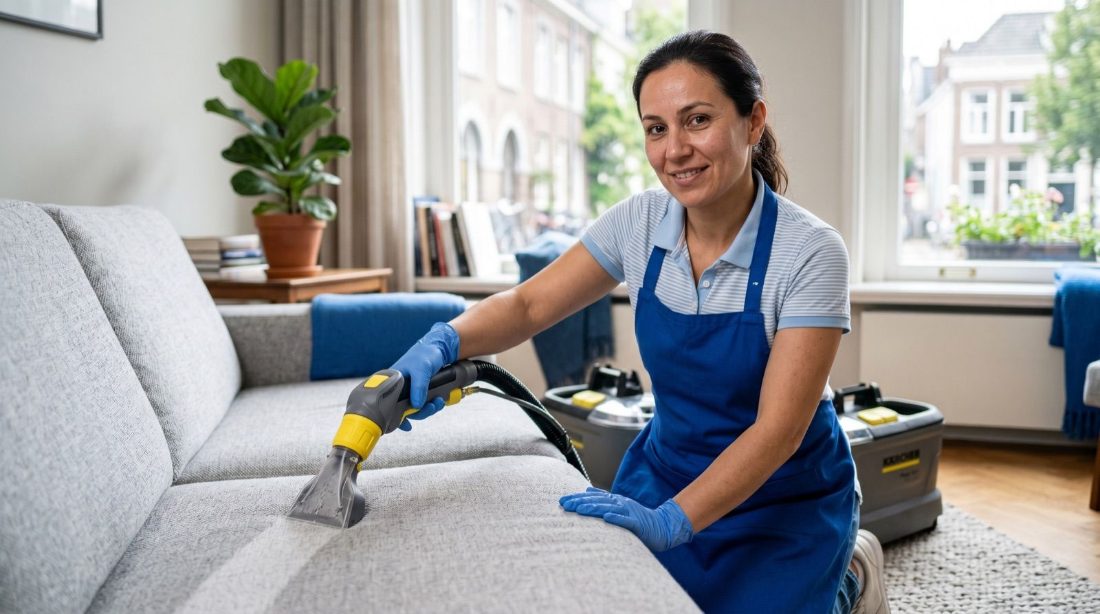
What reaches that is extraction: a machine that injects a cleaning solution into the fibre and immediately draws it back out along with everything suspended in it. It is the same principle as the scrubber-dryer on a floor, and the same reason it works — the dirt leaves with the water instead of drying back in.
The honest guidance is once or twice a year for a family sofa, less for a lightly used one, and immediately after any of the events that end a sofa’s life early: a spill left to dry, an illness, a move. We wrote the detail in carpet, sofa and mattress cleaning explained, and the service itself is here.
And the thing you sleep on
Everything above applies more strongly to a mattress, for a reason that is easy to state and hard to un-hear: you spend roughly a third of your life pressed against it, breathing.
A mattress receives skin, hair and a significant amount of moisture every night, and it has the same deep-fibre structure as a sofa with none of the washing. Vacuuming the surface with the upholstery tool when you change the sheets takes two minutes. Airing it — sheets off, window open, an hour — does more for it than anything you can buy. And a proper extraction clean once every year or two is the only thing that reaches what is below the surface.
It is the least glamorous item in the house and the one in closest contact with you. That combination is exactly why it gets forgotten.
Frequently asked questions
How often should I vacuum the sofa?
Monthly is a good baseline for a normally used living room, fortnightly with pets or small children. The cushions and the seams matter more than the flat faces.
Can I wash the cushion covers?
Check the label — many are washable, and many shrink. If they are washable, wash them cool, do not tumble dry them, and put them back on while very slightly damp so they regain their shape.
Does baking soda on upholstery work?
It can absorb some odour if left long enough and then vacuumed out thoroughly. It does nothing for what is bonded deep in the fibre, and if it is not fully removed it becomes its own grey residue.
Is a steam cleaner safe on a sofa?
Depends entirely on the fabric — some are fine, some mark permanently with heat and moisture. Check the cleaning code on the label, and test somewhere hidden. If it is a code that forbids water, do not experiment.
My sofa still smells after cleaning. Why?
Because the smell is deeper than the clean reached, or because it is in the foam rather than the cover. That is the point at which extraction is the only thing that will work — nothing sprayed on the surface reaches the inside.