






The short answer
- The dark speckles in the corner of a sill are usually the first sign of condensation, not dirt.
- Grit in the frame track wears the rubber seal, and a worn seal lets in more cold air than dirty glass ever does.
- Those little slots at the bottom of a frame are drainage. Blocked, the water sits against the seal.
- Autumn is the moment: heating on, windows shut, condensation starting.
- Every visit is checked in with an NFC tag on the wall and photographed, so you can see what was done on the sill, not just the glass.
What’s in this guide
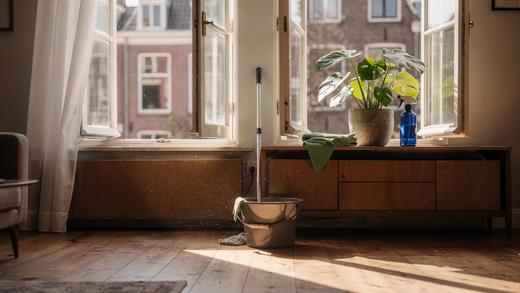
In a lot of Maastricht flats the window sill is deep enough to sit on, and by the end of October it holds a fine grey film, two dead flies, a ring of potting soil where a plant used to be, and a damp line along the back edge where the glass met the cold night. The glass itself may have been cleaned a month ago. That sill has not been touched since spring.
The sill in October
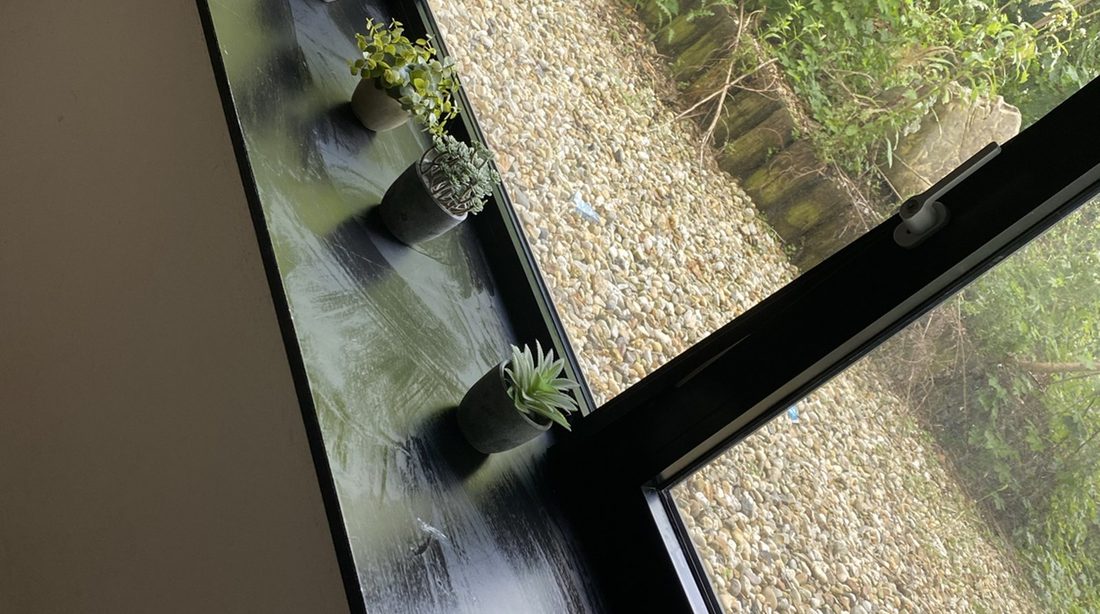
Run a finger along the back edge of a sill, the strip right where the plaster or the wood meets the glass. That is where the dust settles hardest, because that is where nobody wipes: the cloth goes round the plant pot, along the front, and stops. Behind the pot there is a dry crust of soil and a pale ring. Along the back there is often something else — a faint grey line that does not come off with one pass.
That line is condensation dust. Warm indoor air carries dust and cooking grease; it meets the coldest surface in the room, which in autumn is the glass and the metal or wood immediately below it; the water lands and the dust lands with it and dries in place. Do that every night from October to March and you get a stripe that behaves more like paint than like dust.
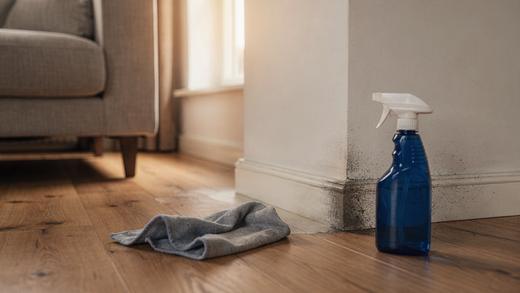
The dark speckles that appear in the bottom corner are the next stage. People see them and assume dirt, or assume the worst. Usually it is neither: it is the beginning of mould in a spot that stays wet a few hours longer than the rest of the sill, because the corner is where the water runs to and where the air moves least. Caught early, it wipes away and stays away for the season. Left until February, it has gone into the paint, into the silicone joint, and into the grout under the sill tile, and then it is a repair rather than a clean.
This is the argument for doing it now rather than in April. Spring cleaning a window sill is tidying up six months of damage. Autumn cleaning it is removing the food and the head start, just before the weather hands it both.
The track under the window that nobody opens
Most houses have one window that gets opened daily and three that get opened twice a year. The three collect everything. Along the bottom of the frame, in the channel the casement closes into, you will find a grey-brown line of grit: brick dust, pollen, cigarette ash from the street if you live on a busy corner, sand, and in the Jekerkwartier a surprising amount of fine limestone dust. Press a thumb into it and it is slightly greasy. Hoover it and half of it stays.
Grit in that channel is not only ugly. When the window shuts, the rubber seal presses down onto it, and sand under rubber does what sand under rubber always does. The seal flattens, then cracks at the corner, then stops sealing. A window with a tired seal loses more warmth than a window with dirty glass ever will, and it whistles on a west wind. A tenant then reports a draught and gets told the frame is old, when what happened is that nobody ever took the grit out.
The corners are the real work. A flat cloth cannot reach into a right angle, so the dirt sits in the two centimetres at each end and rebuilds from there within weeks. That is why we go in with a dry brush first, then a narrow nozzle, then a damp microfibre wrapped round something thin and blunt, and only then the cloth. In that order, or you are just making mud.
The small holes at the bottom of the frame
Open a window and look at the bottom face of the frame, on the outside edge. On aluminium and plastic frames you will see one or two slots, a centimetre or so wide, sometimes with a little plastic flap over them. On older wooden frames it is a drilled hole or a shallow channel cut into the wood.
They are not a manufacturing mistake and they are not a draught to be sealed up with filler, which is what people do when they find them. They are drainage. Rain that gets past the outer edge of the window is meant to collect in the bottom of the frame and leave through those holes. Block them with moss, a dead spider, paint from a careless decorator, or a strip of tape, and the water has nowhere to go. It sits in the frame, against the seal and against the wood, all winter. Then in March somebody finds a soft patch at the bottom of the frame and a black bloom on the plaster below the sill, and blames the shower, or the neighbour, or the house.
Clearing them takes seconds and no chemicals. We look, we poke gently with something soft enough not to scratch the coating, we flush a little water through, and we watch it come out the other side. If it does not come out, that is worth knowing before the first real storm off the Maas.
What not to reach for
Steam is the wrong tool here, and we say that as people who own the machines and use them elsewhere. Aim steam at a cold pane in autumn and you are pushing hot moisture into the one place you are trying to keep dry; on old wooden frames it lifts paint, and in a joint that already has mould it drives water deeper before it kills anything. Steam cleaning earns its place on tiled floors, on grout and on upholstery. Not on a window in November.
Bleach on a mould spot is the other reflex. It takes the colour out, which feels like success, and leaves the roots and the moisture that fed them. Two weeks later the speckles are back in exactly the same corner and now the paint is thinner. Scouring cream on a plastic frame is worse in a quieter way: it puts fine scratches into the surface, dirt then keys into the scratches, and the frame never looks properly clean again no matter who cleans it.
Abrasive nothing, patience something. A sill that is wiped properly in October needs a light pass in December, not a rescue.
What we actually do, in order
If you have booked the glass, ask whether the frames are in it — with a lot of window cleaning in Maastricht, they are not, and it is fair enough that they are not, because they are a different job with different cloths. Ours goes like this. We clear the sill first and put the plants on a towel on the floor, because a plant moved ten centimetres and put straight back tells you nothing about whether the sill got cleaned. Dry brush the frame track and the corners. Hoover. Check and flush the drainage holes. Then the wet work: a mild solution on the sill and frame, corners with a thin folded cloth, rinse cloth, dry cloth, and the joint along the back edge last, dried properly so it does not sit damp for an hour. Then the glass, in that order, so grit from the frame does not end up smeared across the pane.
When we are done, the tag on the wall gets tapped again and the work is photographed — the sill, the corner, the track — and those photos are reviewed against the checklist for that room before the job is closed. It is a plain thing but it changes what gets skipped, because the corner of a sill is the easiest place in a house to skip and the easiest place to see in a photo. The tag exists because everybody in the trade knows exactly which two centimetres get missed on a Friday afternoon.
You can have this as part of a window washing visit, as one room in a deep clean, or written into a regular visit so it happens twice a year without you remembering. If you are trying to work out how often should you clean your home in this respect, sills and frames are a spring-and-autumn item, not a weekly one — the autumn one being the one that actually matters.
Offices, rentals and the mould spot at inspection
In offices the sill is where the building gets judged. It is at eye height when someone sits down, it is where the cables and the sad cactus and the half-drunk glass of water live, and in a room with a lot of people breathing in it the condensation line builds faster than it does at home. Meeting rooms along a south wall are the worst: warm bodies, closed windows, cold glass by five o'clock. We do sills and frames as a named line in office cleaning for that reason, and in restaurants the same holds with grease added to the recipe.
If you rent, one thing is worth knowing without anybody pretending to be your lawyer. In broad terms, in the Netherlands, ordinary ageing of a home is not something a tenant pays for at the end of a tenancy, while damage that comes from how the place was kept can be. Mould at a window sits awkwardly between the two, because it depends on ventilation, on heating, on the building itself, and on what was reported and when — which is exactly why photographs of the state of a sill, taken during the tenancy rather than on the last morning, are worth having. That is the general shape of it and not advice; if it becomes a dispute about your deposit or your rent, the Huurcommissie is the body that decides, and for anything else het Juridisch Loket will point you the right way.
Either way, the argument is easier when the corner is clean. We work in English as well as Dutch, we are insured and registered with the Dutch Chamber of Commerce, and our rating on Google sits at 5.0 — most of which, for this kind of work, comes down to whether somebody bothered with the two centimetres in the corner.
Frequently asked questions
Is cleaning the window frames and sills included when I book window cleaning?
Ask, every time, with any company. It is often not, because the glass and the frame are different jobs with different cloths and different tools. With us you can have the frames, sills and tracks done together with the glass, or as part of a deep clean; say so when you ask for the quote so the visit is planned with the time for it.
Why is autumn the right time to do sills and frames?
Because the heating goes on, the windows stay shut, and the glass gets cold at night. That combination makes condensation, and condensation turns dust into a stripe and a damp corner into a mould spot. Cleaning in October removes the food and the head start. Cleaning in April removes the damage.
There are black speckles in the corner of my sill. Is that dangerous?
Usually it is early surface mould in the spot that dries last, and it wipes off. What matters is why that corner stays wet: a blocked drainage hole, a tired seal, a room that is never aired, or a cold outside wall. We clean it and tell you what we saw. If it keeps coming back in the same place, that is a building question rather than a cleaning one.
Can I just seal up the little holes at the bottom of the frame to stop the draught?
No. Those are drainage holes, and they are how rainwater that gets into the frame leaves again. Sealed or blocked, the water stays in the frame all winter against the seal and the wood. If a window is draughty, the seal or the closing mechanism is the thing to look at, not the drainage.
Do you work in English?
Yes. The team works in English as well as Dutch, which matters in a city with this many students, expats and short lets — you can point at a sill and explain the problem in whichever language you think in.
How do I know the sills were actually cleaned and not just the glass?
Every visit is checked in with an NFC tag on the wall and the work is photographed, and those photos are reviewed by AI against the checklist for the room before the job is closed. A missed sill corner is obvious in a photograph, which is rather the point.