

The short answer
- Dust plus wheels is a grinding paste. It wears sealed concrete from the surface down.
- Once the seal is gone, the slab absorbs oil and water, and no cleaning restores it.
- The costly incident is not the dramatic one — it is the ordinary slip that gets reported.
- A mop spreads a thin film; a scrubber-dryer lifts the water back out. That is the whole difference.
- Frequency beats intensity: a short daily sweep costs less than a monthly rescue.
What’s in this guide
Nobody ever lost a customer because a warehouse floor was grey. That is exactly why it stays grey — it is the one surface in a business with no obvious commercial consequence, so it drops to the bottom of every list and stays there. The argument for cleaning it properly is not aesthetic, and anyone making an aesthetic argument will lose it. It is that a dirty industrial floor is quietly expensive in four specific ways, and three of them are invisible until they are not.
This is not an argument about looks
Start here, because it decides whether the rest is worth reading. A warehouse is a working space and nobody expects it to look like a showroom. If the case for cleaning it rests on appearance, it will always lose to something more urgent — and it should.
The real case is that an industrial floor is a capital asset with a finish on it, and that finish is doing four jobs: keeping the concrete sealed, keeping the surface even for wheels, keeping it non-slip, and keeping dust out of the air and off the stock. Every one of those degrades with dirt, and three of them cost money long before anybody comments on how it looks.
Dust plus wheels is a grinding paste
This is the mechanism nobody sees. Fine grit and dust settle on a sealed floor. A pallet truck or forklift wheel rolls over them under load, and the grit is pressed and dragged across the surface — which is, precisely, how grinding works.
Every wheel in a dusty warehouse is a slow polishing machine running the wrong way.
The result is a floor that wears fastest exactly where it is used most: the main runs, the turns, the loading area. First the seal dulls, then it thins, then it is gone in the traffic lines while the corners still look new. And once the sealer is worn through, the concrete underneath is porous — it starts absorbing oil, water and whatever gets spilled, and at that point no amount of cleaning brings the surface back. Re-sealing or grinding is a capital job with the building shut down, and it is orders of magnitude more expensive than having swept.
The slip that gets reported
The safety argument is usually made with dramatic examples, which is why it gets discounted. The realistic version is duller and more likely.
A thin film of dust on a smooth floor reduces grip in a way nobody notices until they turn quickly. Add a little moisture — a wet day, a condensation patch under a roller door, a leaking pallet — and the slip risk rises sharply, because dust and water together are more slippery than either alone. The incident is not usually spectacular. It is somebody going down awkwardly while carrying something, and then it is reported, and then it is an investigation, an absence, an insurance question and a conversation about whether the floor was maintained.
The uncomfortable part of that conversation is that it is documentary. "Is there a cleaning schedule for this area, and can we see the record?" is a much easier question to answer when the answer is yes.
What it does to stock and to the air
Two quieter costs.
Stock. Dust on the floor does not stay on the floor — every vehicle movement puts it back in the air, and it settles on packaging. Dusty cardboard is a returns argument in food, pharma and anything sold on presentation, and in a clean-critical environment it can be a compliance problem rather than an embarrassment.
Air. People work in it all day. Fine dust from concrete wear is not pleasant to breathe, and a workforce that sees the state of the floor draws conclusions about how the place is run that extend well beyond the floor. That last effect is real and almost never counted.
Why a mop makes it worse
Here is the part most businesses get wrong, and it is the same mistake households make with kitchen floors.
A mop and bucket on a large industrial floor does not remove dirt; it suspends it in water and spreads it thinly over a bigger area, then leaves it to dry. What dries is a film of everything that was already there. Do that weekly and the floor gets progressively duller and greyer no matter how much effort goes in — which is exactly the experience that convinces people the floor is simply old.
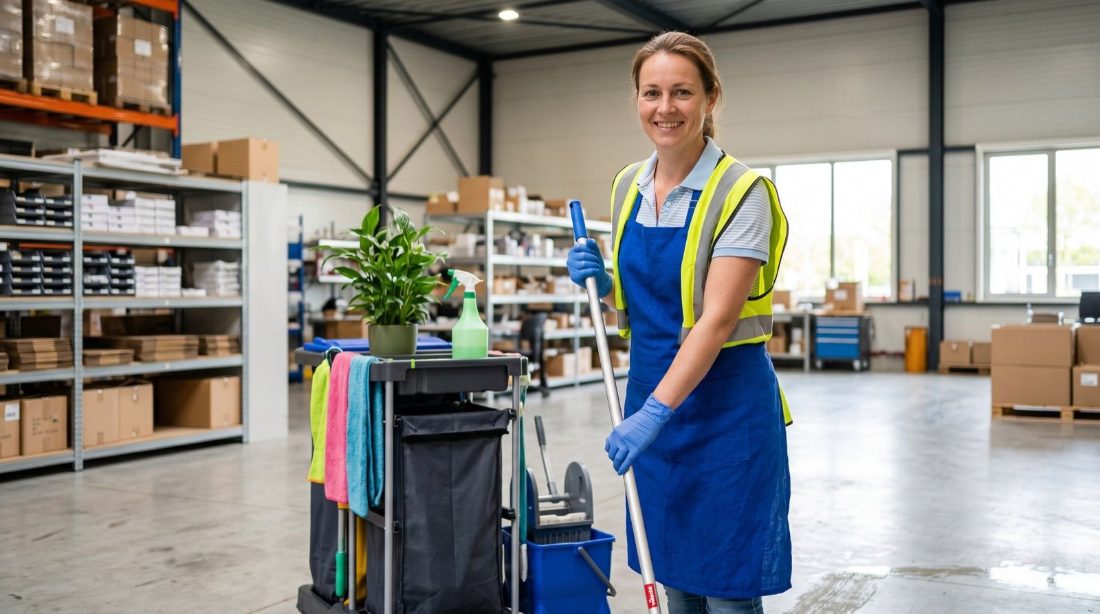
The equipment that actually solves it is a scrubber-dryer: it lays down water, agitates with brushes or pads, and immediately vacuums the dirty water back up, so nothing is left to dry. That single difference — the water leaves with the dirt in it — is why a machine-cleaned floor looks different and stays looking different.
For daily work, a sweeper or a dust-control mop matters just as much, because removing the grit is what stops the grinding. Wet-cleaning a floor that has not been swept first is simply making mud, and mud is abrasive too. That is machine floor work in a sentence: sweep first, scrub second, and lift the water back out.
A schedule that fits around a shift
The practical objection is always the same: the floor is never empty. That is solvable, and the answer is frequency rather than intensity.
- Daily: sweep the traffic lines and the loading area, and deal with any spill the hour it happens. Ten minutes. This is the one that protects the floor.
- Weekly: machine-scrub the main runs, worked around the racking rather than through it.
- Monthly: the edges, under the racking where a machine cannot reach, and the areas nothing drives over — which is where dust accumulates and then gets kicked back into circulation.
- Annually: an honest look at the seal in the traffic lines, before it is gone rather than after.
Outside operating hours is usually easiest, and it is how most industrial cleaning is scheduled — including ours, with the visit confirmed on site and every finished area photographed, so the record exists without anybody having to walk round and check. That record is not a sales feature; it is the thing that answers the question in the paragraph about the slip.
Frequently asked questions
How often does an industrial floor actually need machine cleaning?
It depends entirely on traffic. A busy distribution floor benefits from weekly scrubbing of the main runs; a quiet storage unit may need it monthly. The daily sweep matters more than the scrubbing frequency, because grit is what causes the wear.
Can we just do it ourselves with a mop?
For small areas and spills, yes. For anything above a few hundred square metres a mop spreads more than it removes, and the labour cost of doing it badly usually exceeds the cost of doing it with a machine.
Is a sealed floor worth it?
Generally yes — it keeps the concrete from absorbing oil and water and makes cleaning far more effective. The condition to attach is that a seal only lasts if grit is kept off it, which brings you back to the daily sweep.
What about dust in the racking itself?
It matters more than most people think, because it falls onto stock and back onto the floor. High-level cleaning is a separate, less frequent job and usually needs the area cleared, so it is planned rather than squeezed in.
Do you work outside operating hours?
Yes, and for most industrial sites that is the only realistic option. Evenings, nights and weekends are normal for this type of work.