





The short answer
- Clean the lint filter after every load, not every week. It takes ten seconds while the washing is still in your arms.
- A condenser or heat-pump dryer has a second filter behind a flap at the bottom. Most people have never opened it.
- A vent hose crushed flat behind the machine is the commonest reason drying takes two cycles.
- In a shared laundry room, the lint that matters is the lint on the floor behind the machines, where nobody looks.
- Who pays for what in a rental is decided by the Huurcommissie or het Juridisch Loket, not by us.
What’s in this guide
Open the door of a dryer that has been running all week and pull the filter out of the frame. What comes away is not dust. It is a sheet of grey felt, thick enough to peel off in one piece, and if the last load was towels it has a bluish tinge; if it was black jeans it looks like the inside of a chimney. That felt is cotton. Cotton that is warm, dry and sitting next to a heating element.
The grey felt you peel off the filter
Lint is not dirt that arrived from outside. It is your laundry, leaving. Every tumble a towel makes in a hot drum knocks loose a few thousand short cotton fibres, and the air that carries the moisture out carries them with it. Some get caught in the mesh in the door frame. The rest go further in.
What makes it a fire story rather than a housekeeping story is simple enough to say in one sentence: fine, dry cotton fibre packed into a warm, airless space is excellent tinder, and a dryer works by being warm and moving air. Block the air and the heat stops leaving. Fire services across Europe deal with dryer fires every year, and the cause is almost never a dramatic fault. It is a filter nobody emptied and a hose nobody looked behind.
So the first habit is not glamorous. Pull the filter out while the dry washing is still in your arms, peel the felt off with your thumb, drop it in the bin, slide the filter back. Ten seconds. Do it after every load, not on Sundays, because the one load you skip is the one where the mesh goes from grey to sealed.
If the mesh looks clean but water beads on it instead of running through, that is fabric softener and dryer sheets, which leave a film you cannot see. Rinse the filter under the tap, work the mesh with a soft brush, and let it dry completely before it goes back. A wet filter in a hot drum is how you get that smell people describe as "warm dog".
Two kinds of dryer, two different jobs
In Maastricht you meet both, often in the same building.
The older vented dryer pushes hot wet air down a flexible hose. In a terraced house on the Wyck side that hose usually goes through a hole in the wall; in a student room it goes out of the window with a towel stuffed around it. The hose is the weak point. It is concertina-shaped on the inside, so lint catches on every ridge, and when the machine is shoved back against the wall the hose gets folded, crushed or kinked behind it. A flattened hose means the air cannot get out, which means the moisture cannot get out, which means you run the machine twice and blame the machine.
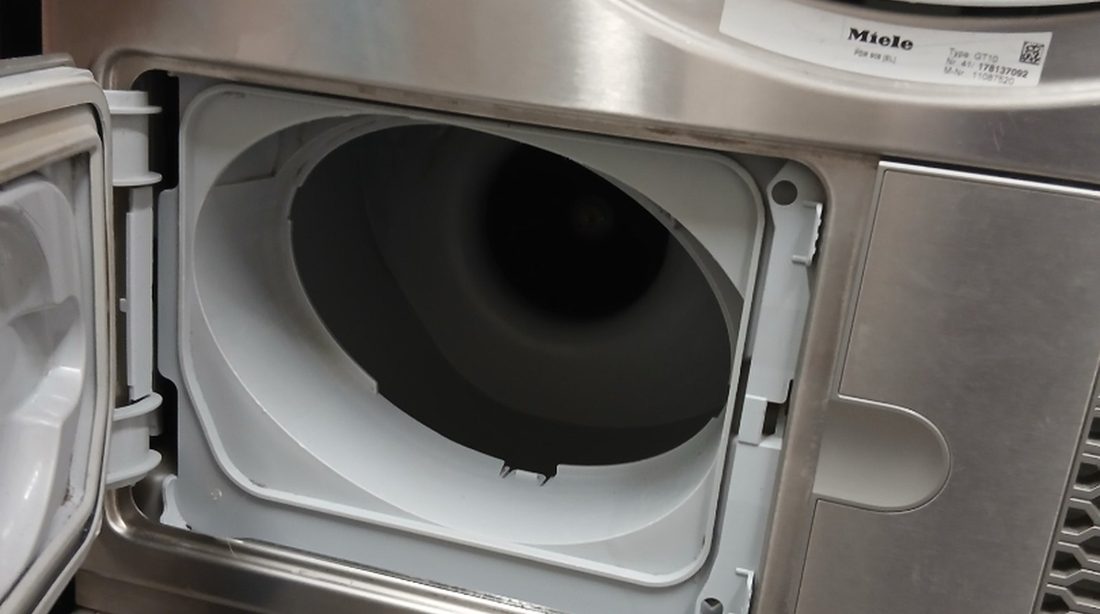
The newer condenser and heat-pump dryers do not vent at all. They cool the air down, wring the water out of it into a tank or a drain hose, and reheat it. That means the moisture goes in a tank you empty — and it also means the lint that escapes the door filter has to be caught somewhere else. On most of these machines there is a flap at the bottom front, below the door. Behind it sits a sponge-like foam filter and, behind that, the heat exchanger: a block of thin metal fins, very fine, packed close.
Open that flap on a dryer that has been in a holiday flat for a season and the foam is usually felted solid, and the fins have a mat of lint across the front like the grille of a car in summer. The machine will still run. It will just take forever, cost more in electricity, and run hotter than it was designed to.
What we do, in order, with our hands
When a dryer is part of a deep clean, this is the sequence. You can do the same thing yourself with a vacuum and a bit of patience.
- Switch it off at the socket. Not standby. Off.
- Pull the door filter, peel the felt, rinse the mesh, set it somewhere to dry. Then vacuum the slot the filter sits in, with the narrow nozzle, pushed right down. There is always more in there than on the filter itself.
- Wipe the door seal with a damp cloth, running a finger round the bottom of the rubber where lint and a stray hairclip collect.
- Open the bottom flap. Take out the foam filter, rinse it under the tap until the water runs clear, squeeze it in a towel, leave it out to dry properly.
- Vacuum the face of the heat exchanger fins, straight on, never sideways — the fins bend if you push across them. What the vacuum will not lift comes off with a soft brush and a light hand.
- Empty and rinse the water tank, and look at the little hole it drains through. If the tank smells, that hole has a plug of wet lint in it.
- Pull the machine out far enough to see behind. On a vented dryer, take the hose off, shake it out over a bin bag, look through it at the light, and refit it so it curves instead of folding. Vacuum the floor and the skirting behind the machine. On a heat-pump dryer, vacuum the grille at the bottom back where it takes room air in.
- Push it back, leaving a hand's width of air, and run it empty for five minutes to be sure everything you took out went back in.
That is the whole job, and it is the kind of job that is easy to say you did. Which is why every visit we make is registered at the door — the cleaner taps their phone on a small sticker on the wall — and the work is photographed. Those photos are checked against the checklist for that room, automatically first and then by our manager, before the job is closed.
The shared laundry room in a student building
A basement in the centre, two dryers side by side, a bulb on a pull cord and a window well that has not opened in living memory. Fifteen people use those machines, and not one of them considers the filter theirs.
If you own or manage that building, these are the things worth putting your head in the room for:
- The floor behind and under the machines. In a shared room this is where the lint goes. A soft grey drift along the skirting is the warning sign, and it is also the thing cleaners who only mop the visible floor never reach.
- Hoses. Count the folds. A hose that leaves the machine and immediately turns ninety degrees into the wall is a hose full of lint.
- Where the warm air actually goes. Venting a dryer into an unventilated basement does not remove the moisture from the building; it just moves it onto the walls. Black spotting in the corner above the machine is that moisture coming back to you.
- Something written on the wall. A laminated note, in Dutch and English, telling residents to peel the filter after every load. In a student building the second language is not a courtesy, it is the difference between being read and not.
- Who opens the bottom flap, and how often. If the answer is nobody, that is the gap.
For a building, laundry rooms sit naturally alongside the stairwell on the same round, and for a short-stay flat they belong in the changeover between guests — because a guest who finds the filter already felted over will run the dryer three times, get damp towels, and write about it.
What lint cleaning is not for
Steam is wrong here. A steam cleaner is a fine tool for grout and for a tiled shower wall, and it has no business inside a dryer: you are adding moisture to the one part of a laundry appliance that must stay bone dry, and warm damp lint is worse than dry lint, not better.
Compressed air is also wrong, at least indoors. Blowing a heat exchanger with an airline gets the lint out of the machine and into the room, which means into the air you are breathing and back in through the intake grille within the hour. Vacuum pulls. Pull, do not blow.
And this is housekeeping, not repair. If the drum squeals, if the machine smells of hot electrics, if it trips the group, if the outside of the casing is too hot to hold a hand against, stop using it and get an engineer. A clean filter will not fix a failing thermostat, and nobody should pretend otherwise.
Who is supposed to do it in a rented flat
This comes up constantly, in houses, in student rooms, in flats above shops. The dryer belongs to the landlord. Who keeps it clean?
In broad terms — and this is the general shape of how these things are looked at in the Netherlands, not advice, and certainly not a reading of any specific rule — the small, routine, everyday upkeep of something you use tends to sit with the tenant, while repairing or replacing what has genuinely worn out or failed tends to sit with the landlord. Emptying a lint filter is about as routine as upkeep gets. A heat exchanger that has never been touched in the life of the machine is a different conversation, and so is damage caused because nobody ever explained that there was a flap at the bottom.
If money is actually at stake — a deduction from your deposit, a repair bill you think is not yours, a dispute about who let the machine get into that state — do not settle it from a blog. Rent and deposit questions are for the Huurcommissie; anything else, het Juridisch Loket will tell you where you stand for free. What we can do is leave photographs of the condition we found and the condition we left, which is more than most people have when the argument starts.
We are Elizabet M Cleaning — insured, registered with the Dutch Chamber of Commerce, rated 5.0 on Google, working in English as well as Dutch across Maastricht and the rest of Limburg, and if your dryer is taking two cycles to do one load, ask for us to open the bottom flap when we come.
Frequently asked questions
How often should the lint filter be cleaned?
After every load. It is a ten-second job while the dry washing is still in your hands, and it is the single thing that matters most. Once a month, also rinse the filter under the tap with a soft brush, because fabric softener leaves an invisible film that stops air passing through clean-looking mesh.
My condenser dryer takes two cycles to dry one load. Why?
Usually the filter behind the bottom flap and the heat exchanger behind it. If the foam is felted solid and the metal fins have a mat of lint across them, the machine cannot shed heat or moisture properly, so it runs and runs. On a vented dryer, look instead at the hose behind the machine for a crush or a fold.
Can you clean the dryers in a shared laundry room?
Yes, and in a shared room the floor behind and under the machines usually needs it more than the machines do. It fits well onto the same round as the stairwell and the bin store, and each visit is logged with the tag on the wall and photographed, so you can see the state of the room without going down to the basement.
Is it safe to use a steam cleaner on a tumble dryer?
No. Steam is a good tool for grout, tiles and some hard floors, but inside a dryer you would be putting moisture into the one place that has to stay dry, and damp lint packs harder than dry lint. Use a vacuum with a narrow nozzle and a soft brush.
Do you work in English?
Yes. The team works in English as well as Dutch, which matters in laundry rooms shared by students and short-stay guests, where instructions on the wall only work if people can read them.