

The short answer
- In twenty minutes you are managing first impressions, not cleaning a home. Different job.
- A guest sees three rooms: the entrance, wherever they sit, and the toilet. Spend everything there.
- Clear before you clean. A clear surface reads as clean even when it is not; a cluttered clean one does not.
- Smell is judged in the first four seconds and is half the impression. Ventilate; do not spray.
- Deliberately skip the bedroom, the oven, the floors under furniture and anything above eye level.
What’s in this guide
Somebody is coming in an hour. You have perhaps twenty usable minutes, because the rest will go on you and the kettle. The instinct is to start with whatever is annoying you most, which is usually the wrong thing entirely — the thing that has been annoying you for a month is invisible to a guest who has never seen the room before. What follows is what professionals do when a job has a hard stop: not clean everything badly, but clean the right things properly and leave the rest alone.
You are managing perception, not dirt
This is the mental switch that makes the whole thing work, and people resist it because it feels like cheating. It is not cheating; it is simply a different task with a different goal. Cleaning a home makes it clean. A reset makes it read as looked-after to somebody who will be there for two hours and will see perhaps a fifth of it.
A guest forms an impression in the first minute and then stops evaluating. They will notice the hallway, the room they sit in and the toilet, in that order, and after that they are looking at you and not at your skirting boards.
Guests do not audit a home. They take one photograph in their head at the door and refer to it all evening.
The twenty minutes, minute by minute
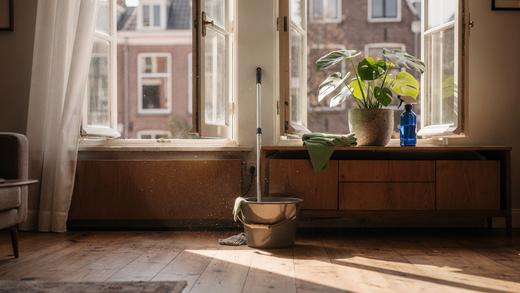
Minutes 0–2: open the windows. Both ends of the flat, wide, before anything else. Air needs the whole twenty minutes to work, so it must start first. This single step does more than any other on this list.
Minutes 2–6: clear, do not clean. Take a laundry basket and walk one loop of the rooms your guest will see. Anything that does not belong goes in it. Do not sort, do not put away, do not open drawers — just clear. Surfaces first, then floors. A clear coffee table reads as a clean room; a wiped but cluttered one does not.
Minutes 6–10: the toilet. Non-negotiable, and the one room where a guest is alone with their thoughts and your grouting. Bowl, seat both sides, the flush handle, the tap, the basin, the mirror. Fresh hand towel. Put the loo roll on properly. Bin emptied if it is anywhere near full.
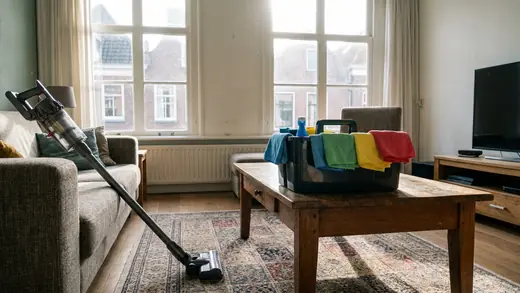
Minutes 10–14: the room they will sit in. Cushions straightened, throws folded, the coffee table wiped, glasses and mugs removed. Then a quick vacuum of the visible floor only — the middle, the traffic lines, not under anything.
Minutes 14–17: the kitchen worktop and the sink. Not the cupboards, not the oven. Clear the worktop completely, wipe it, and empty the sink. An empty sink is worth more than a scrubbed hob, because a full sink is the one thing that reads as "we did not expect you".
Minutes 17–19: the entrance. Shoes lined up or moved, coats made to look deliberate, the doormat straightened and the glass in the front door wiped if there is any. This is where the first impression is actually formed, and it is almost always the last place anybody thinks of.
Minute 19–20: close the windows, put the lights on, sit down. Being visibly out of breath when the doorbell goes undoes some of the work.
What to deliberately skip
This matters as much as the list above, because twenty minutes spent partly on the wrong things is what turns a reset into a panic.
- Bedrooms. Close the door. A closed door is a complete answer.
- The oven, the fridge, inside anything. Nobody is opening them.
- Floors under and behind furniture. Invisible from a sofa.
- Anything above eye level. Nobody looks up in a house they are visiting.
- Windows. Twenty minutes is not a window job, and a half-done window is more visible than a dirty one.
- Sorting the pile you just made. That is tomorrow's job and it is fine.
Smell and light do the rest
Two cheap levers that work disproportionately.
Smell. A room is judged in about four seconds, and most of that judgement is not visual. Ventilation is the entire answer — and specifically not an air freshener, which announces that something needed covering. If you have three spare minutes, take out the rubbish and run the tap in any sink that has not been used today; a dry trap is the most common unexplained smell in a flat. There is more on this in what clean actually smells like.
Light. Turn on more lamps than feels necessary and fewer overhead lights. Side lighting flatters a room and hides exactly the things you did not have time for; a bright ceiling light does the opposite. This is why restaurants are lit the way they are.
The box trick, and its one rule
The laundry basket in minute two is the oldest trick in domestic cleaning and it works perfectly — with one rule that everybody breaks: the box must be emptied within twenty-four hours.
Break that rule and you have not tidied, you have created a permanent object: the box in the spare room that nobody ever opens, which by March contains a phone charger, three letters that needed answering and a set of keys. Set a reminder if you have to. The trick is a deferral, not a disposal.
Why this is not cleaning, and that is fine
None of this makes a home clean, and it is not meant to. Dust is still on the shelves, the bathroom floor is still due, and the kitchen still has a real job waiting in it. A reset borrows against that and the loan comes due.
What it does do is separate two things people confuse: tidy is fast and visible, clean is slow and mostly invisible. Households that feel permanently behind are usually doing the slow one in fragments and never getting the fast one done, so the home never looks better even after two hours of work.
The fix is to do them separately and on purpose. Keep the reset for guests, keep a real clean for a fixed time when nobody is coming — or hand the slow half over entirely, which is what a regular visit is for. Nobody has ever booked a cleaner because they could not straighten cushions; they book one because the slow half never fits.
Frequently asked questions
What if I only have ten minutes?
Windows open, clear the surfaces in the room they will sit in, toilet, empty the sink. In that order, and stop when the time is gone rather than trying to touch everything.
Is it worth vacuuming at all in twenty minutes?
Only the visible middle of the floor in the room they will use, and only after you have cleared it. Vacuuming around objects takes three times as long and shows half as much.
Should I light a candle?
If you like candles, yes. As a way of covering a smell, no — it becomes a second smell on top of the first. Open windows first, always.
My guest is staying the weekend. Same plan?
No. That is a real clean, because they will use the bathroom properly, open cupboards and see the kitchen in daylight. A reset is for two hours, not two days.
Is there a professional version of this?
Yes — an express clean is exactly this logic done by two people with equipment, which is why it is priced and scoped differently from a full visit. It is for the flat before a viewing, or the morning before the family arrive.
What is the single highest-value minute?
Opening the windows, because it is the only thing on the list that keeps working while you do everything else. The second is emptying the sink, which costs thirty seconds and changes how the whole kitchen reads.