

The short answer
- Gravity: work top to bottom. Everything you disturb lands on what is below it.
- Dry before wet: dust and vacuum first. Wet a dusty surface and you make mud.
- One loop: go around the room once, in one direction, and finish each wall as you pass it.
- Dwell time: apply products first, then do something else while they work.
- Floors are always last, and the room you leave from is the door.
What’s in this guide
Watch somebody clean a room for a living and the striking thing is not that they move quickly. They do not, particularly. What is striking is that nothing is ever done twice, nothing is waited for, and they never cross their own path. That is not talent and it is not equipment — it is sequence, and it is the single most transferable thing in this trade. Four rules decide almost the entire difference between a room that takes forty minutes and the same room taking an hour and a half.
Why most people clean every room twice
The usual domestic pattern is to clean whatever is most annoying first, then notice something else, then go back for the cloth, then discover that wiping the shelf has put dust on the floor you have already done. Nothing in that is incompetent. It is simply unordered, and an unordered job repeats itself.
The professional version is not harder. It just refuses to start anywhere except the beginning.
Speed in this trade is almost entirely the absence of repeated work.
Rule one: gravity decides the order
Everything you disturb falls. Dust from a shelf lands on the sideboard; crumbs from the sideboard land on the floor. So you work top to bottom, always: light fittings and the tops of frames, then shelves and pictures, then furniture surfaces, then skirting boards, then the floor.
Do it the other way and you vacuum, then dust, then have to vacuum again — which is exactly the extra half hour most people cannot account for at the end of a session.
The same rule runs through a whole building. Upstairs before downstairs; the top of a staircase down, never up.
Rule two: dry before wet
Dust is easy to remove while it is dry and difficult once it is wet, because water turns loose dust into a smear you then have to remove twice. So every dry process comes first: dusting, sweeping, vacuuming. Only then do cloths and buckets come out.
This is why a professional will vacuum a bathroom floor before mopping it, which surprises people. Hair and dust in a wet mop become a grey paste that goes around the room; removed dry, they are gone in twenty seconds.
And the corollary: damp, not wet. A damp cloth traps and removes dust; a dry one relocates it into the air, and a soaking one leaves streaks that dry back as film.
Rule three: one loop, one direction
Pick a corner, pick a direction, and go around the room once. Finish each section completely as you reach it — the whole wall, the furniture against it, the surfaces on it — and do not come back.
The reason is memory, not elegance. A room cleaned in a loop has an obvious boundary between done and not-done, so you never stand in the middle wondering whether you did the windowsill. A room cleaned by jumping about has no such boundary, which is why people finish and immediately feel they have missed something. They usually have.
Left to right or right to left does not matter. Consistency does, because after a fortnight it stops being a decision at all.
Rule four: apply, then walk away
This is the one that feels wrong and saves the most time. Products need contact time to work — the oven cleaner, the limescale remover, the toilet cleaner, the degreaser on the hob. Applying one and immediately scrubbing means you are doing by hand what the chemistry was about to do for you.
So the professional sequence in any wet room is: apply everything first, in the order things need to soak; then leave the room and do something dry elsewhere; then come back and wipe it all away in one pass.
In a bathroom that means toilet, shower, taps and basin all treated within the first ninety seconds, then you go and dust the bedroom, then you come back to a room where everything has already let go. It is the difference between scrubbing and wiping.
A room, start to finish
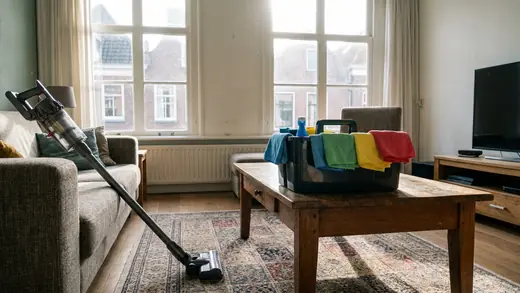
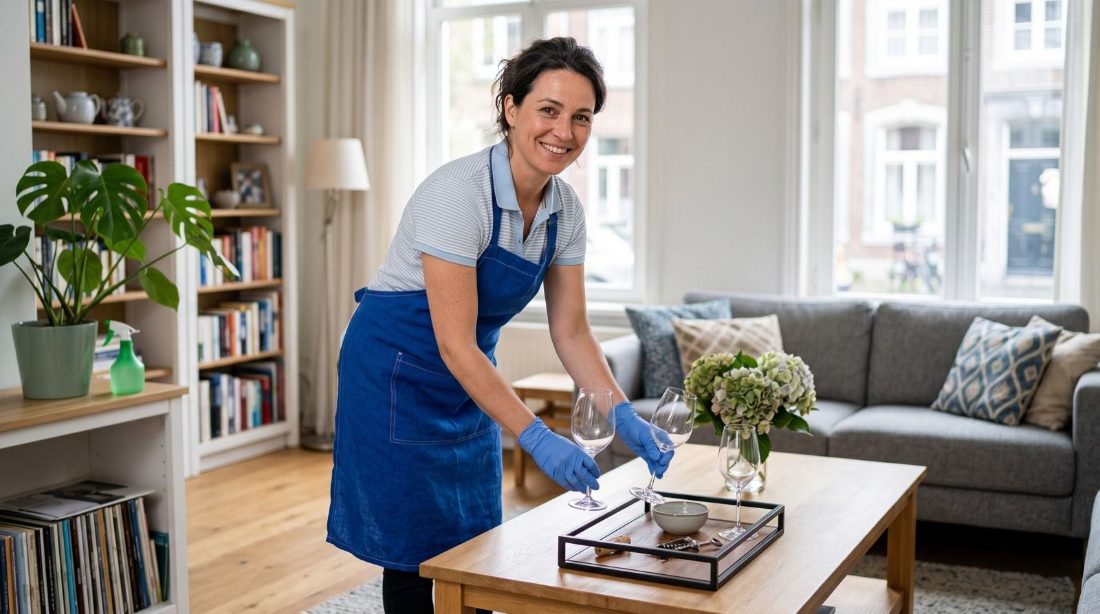
Putting the four together, here is a living room done once:
- Clear. Anything that does not belong goes out of the room now, not during.
- Apply anything that needs to soak, if the room has any.
- High to low, one loop: light fittings, tops of frames and doors, shelves, pictures, sills.
- Surfaces as you pass them, damp cloth, in the same loop.
- Upholstery — cushions lifted, seams done, as covered in the sofa piece.
- Skirting boards and switch plates, which are the two most visibly neglected things in any room.
- Vacuum, edges first and the middle last, finishing at the door.
- Mop if needed, working backwards out of the room so you never walk on it.
Nothing there is clever. The whole gain is that each step is done once.
Three habits that cost the most time
Beyond the order itself, three things add more minutes than anything else, and all three are invisible while you are doing them.
- Fetching. Every trip to the cupboard for one more cloth is a minute, and a session has a dozen of them. Carry everything for the room with you in one caddy, decided before you start. It is the reason professionals look like they are carrying too much.
- Cleaning around objects. Wiping a shelf with six things on it takes roughly three times as long as clearing it, wiping it and putting them back. It also leaves six rings.
- Starting with the worst thing. It feels right and it wrecks the sequence, because the worst thing is usually the oven or the shower — jobs that need soaking time you have not started yet.
Fixing those three is often worth more than any product on any shelf.
And the order of the house
The same logic scales up. Bedrooms and living areas first while you are fresh and the cloths are clean; kitchen and bathrooms after, because they are the dirtiest and you do not want to carry that back through the house. Bins last. And finish at the front door, so the last thing you do is leave.
Two things professionals do that are worth stealing: separate cloths for separate areas, colour-coded so a bathroom cloth can never end up on a worktop, and never put a used cloth back in clean water. Both sound fussy until you think about what the alternative is actually doing.
If you want to see it done properly, it is what a regular visit looks like from the inside: not people rushing, but nobody ever retracing a step. The sequence is the skill.
Frequently asked questions
Does this work for a quick clean too?
Yes, and it matters more when time is short. The rules do not change; you simply stop earlier. What ruins a short clean is jumping around, not the shortness.
Should I dust before or after vacuuming?
Before, always. Dusting drops what it removes onto the floor, so vacuuming first means doing the floor twice.
Why edges first when vacuuming?
Dust collects where the floor meets a wall, and disturbing the edges pushes some of it back into the middle. Doing the middle last picks that up rather than leaving it.
Is colour-coded cloths really necessary at home?
It is not fussiness — it is the simplest way to guarantee a bathroom cloth never touches a kitchen surface. Two colours is enough for most homes.
How long should a living room take?
Done in this order, a normally tidy living room is twenty to thirty minutes without hurrying. Most of the variance between homes is clutter, not dirt — which is why step one is clearing.