





The short answer
- Grease does not dissolve in water. Without degreaser, a mop moves it around and thins it out.
- A mop bucket turns into a fat emulsion within minutes; after that you are painting the floor with what you took off it.
- The grout sits lower than the tile, so that is where the film lives — it needs a brush, not a pass.
- Rinse water goes out with a squeegee to the drain, never back into the bucket.
- A floor is only finished when it is dry, and a half-dry greasy floor is the slippery one.
What’s in this guide
- The film you can feel through a shoe
- Why a mop alone loses this fight
- Hot water, and the right amount of degreaser
- The grout is the floor
- Squeegee it to the drain, don't mop it back
- The part nobody budgets for: drying
- What this method is not for
- Who walks in, and how the work is checked
- Frequently asked questions
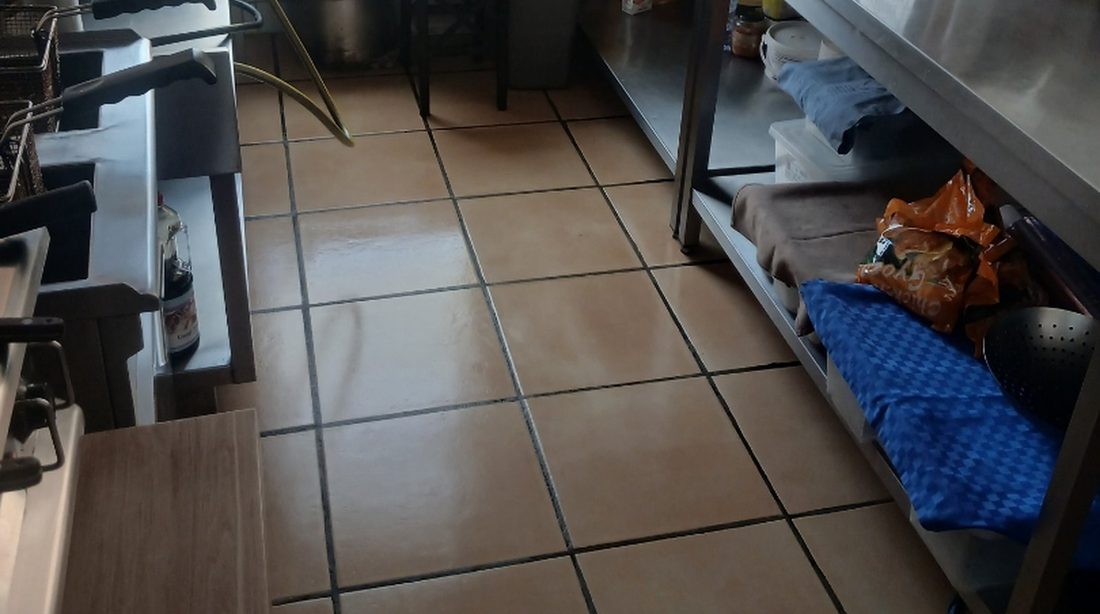
Service is over. The pass is wiped, the fryer is capped, the bucket of grey water is going out the back door. You walk past the stove in your clogs and for half a step the floor holds you — not wet, not sticky exactly, just a fraction slower than it should be. That half step is a film of cooled fat lying over red quarry tile, and no amount of mopping the way most kitchens mop will take it off.
The film you can feel through a shoe
Quarry tile was chosen for your kitchen for good reasons. It is hard, it takes heat, it does not care about a dropped pan, and unglazed, it has a slight tooth to it that grips a wet sole. That tooth is the whole point. It is also the first thing to disappear.
In a working kitchen, fat does not stay where it was cooked. It leaves the pan as vapour, drifts, cools on the way down and lands as a fine mist on everything below the extraction hood — the tiles in front of the stove, the strip under the fryer, the floor along the route between the range and the pass, where drips fall off plates. Cold, that mist is not a puddle you can see. It is a layer, thin as a fingerprint, and it sits on top of the texture of the tile and fills it in.
You notice it in your feet before you notice it with your eyes. Then, later, you notice it as a dull grey haze across a floor you are sure somebody mopped last night. Both of those are the same problem.
Why a mop alone loses this fight
Water and fat do not mix, which every cook knows from the pan and every closing shift forgets at the bucket. Drop a flat mop into warm water and run it over a greasy tile and three things happen. Some of the fat comes up onto the mop head. Some of it smears sideways into the grout lines. And some of it goes into the bucket, where it does not vanish — it emulsifies just enough to stay in suspension in the dirty water.
From the second dip onwards, you are no longer cleaning. You are distributing. The mop comes out of a bucket of fat and water, goes down on the tile, and leaves behind a thinner, wider, more even version of the film you started with. Even is the dangerous part, because even looks clean.
This is why the floor can be mopped every single night for a year and still end up with a grip you do not trust and a grout line that has gone from buff to almost black. Nothing was ever removed. It was only rearranged.
Hot water, and the right amount of degreaser
To lift fat off tile you need three things working together: an alkaline degreaser to break the fat down, heat to soften it so the chemical can get at it, and mechanical work to drive it into the pores and drag it out again. Take any one away and the other two struggle.
So the order matters. We start dry: sweep, and get the grit, the peppercorns, the parsley stalks and the bits of cling film out from under the line and along the kickplates. Grit in a wet floor turns a brush into a sander and a squeegee into a rake. Then hot water — hot, not boiling, because scalding water flashes the surface of the fat and steam-cooks it more than it releases it. Then degreaser, dosed at the rate on the container.
Dosing is where most kitchens go wrong in both directions. Too little and the solution is spent within a metre of the fryer. Too much and you have a floor that will keep foaming through every rinse, and residue that stays behind and attracts the next week's dust, which is its own kind of film. The dilution printed on the bottle is not a suggestion from a marketing department. It is the concentration at which that chemistry actually works, and going past it buys you nothing but rinsing.
The solution goes down and it stays down. It needs contact time to do its job — long enough that the haze on the tile starts to look loosened rather than glossy. Mopping it off the moment it lands is the most common mistake there is; all the chemical does then is get wet.
The grout is the floor
Look closely at quarry tile and the grout line sits a millimetre or two below the face of the tile. Which means a mop head, or a flat pad, or even a rubber blade, never truly touches it. It bridges it. Everything you push along the floor ends up in that channel, and everything the extraction drops out of the air settles into it.
That is why a kitchen floor can look acceptable from standing height and be plainly filthy when you crouch. The tiles have been wiped. The grid between them has been fed.
Grout needs bristle. On a small area, that is a deck brush worked along the lines rather than across them, with weight on it, and then again at right angles to catch the corners of each tile where the two lines meet. On a full kitchen, it is a rotary machine with a stiff brush head, which does in one pass what an arm does in ten and gets under the edge of the line instead of skating over it. Around the feet of the range, along the plinths and in the corner behind the door where the mop has never quite reached, it goes back to hands and a smaller brush. There is no machine shaped like the gap between a fridge and a wall.
Squeegee it to the drain, don't mop it back
Now you have a floor covered in dirty solution holding suspended fat, and the entire outcome depends on where that liquid goes. Into a bucket via a mop head, and you have just made the fat emulsion described above and you will put most of it back. Out to the drain with a rubber-bladed squeegee, and it is gone.
So: squeegee the solution across the tile and into the gully, working in overlapping strokes, always towards the drain and never away from it. Then rinse with clean hot water and squeegee that out too. Then, honestly, rinse again in the corner where you know the grease was worst, because the first rinse will have carried some of the dissolved fat with it and left a whisper behind.
Only at the very end does a clean mop or a dry blade come out, and only to take up the last of the standing water. A mop's job on a quarry-tile kitchen floor is drying, not cleaning. Every kitchen that gets this the wrong way round ends up with the same grey haze.
The part nobody budgets for: drying
A floor with fat still on it does not dry evenly. Water beads on the greasy patches and sits there long after the clean tile has gone matte, which is a useful test — walk back in fifteen minutes later and the wet shapes still on the floor are a map of what you missed.
It also matters for slips. The worst state a kitchen floor can be in is not dry-and-greasy, and not wet-and-clean. It is half-dry water sitting on top of a fat film, because then there is a lubricated layer over a surface whose texture has been filled in. That is the floor where somebody carrying a stockpot goes down.
Which is why the last thing we do is nothing. Air movement, doors where they need to be, and enough time before the first delivery walks through. A clean quarry tile floor comes up chalky and light, and it has that tooth back; you can feel it before you look at it. If it dries shiny in patches, it is not finished, and we would rather find that out than have you find it at half six the next morning.
What this method is not for
This is a quarry-tile routine, and it is wrong for several other floors in the same building.
- Not for polished or sealed stone in the dining room. A strong alkaline degreaser will dull a sealer and can etch some natural stone; that floor gets a neutral cleaner and a lighter hand.
- Not a steam job. Steam is excellent on many things, but blasted at cooled fat on a porous tile it tends to soften and redistribute the grease rather than remove it, and it gives you nothing to squeegee away. Fat wants a chemical, then a brush.
- Not for the hood and the ducting. Extraction cleaning is specialist fire-safety work with its own access and certification, and a floor crew should not be climbing into your ductwork.
- Not a substitute for the nightly close. A deep degrease resets the floor. It is the five minutes of sweeping and a proper rinse each night that decides how long the reset lasts.
Who walks in, and how the work is checked
A kitchen is not a room you hand over lightly. Knives are out, the mise is in the fridges, the pass is somebody's own small kingdom, and the people cleaning it are in there when nobody from your team is watching. So the reasonable question is not what chemistry we use. It is who is standing on your tiles at midnight and what proof you get in the morning.
Every visit starts with an NFC tag on your wall: the cleaner taps it on arrival, so the time is logged where the work happened rather than typed in afterwards. The work gets photographed — the grout line in front of the range, under the fryer, the corner behind the door — and those photos are reviewed by AI against the checklist for your kitchen before the job is allowed to close. If the corner with the worst build-up has no photo, or the photo does not match what the list asks for, the job is not finished. That is a different conversation from "the lads say it's done".
We are insured and registered with the Dutch Chamber of Commerce, and we are rated 5.0 on Google. We work in English as well as Dutch, which in a Maastricht kitchen with a Spanish sous, a Polish KP and a Dutch owner is less of a detail than it sounds. If you want the whole picture of what a restaurant cleaning visit in Maastricht covers — line, floors, walls, fridges, the stainless nobody likes doing — that is the page for it, and the same crews work out through Valkenburg, Meerssen and Sittard.
Go and stand in front of your stove now, in your own shoes, and shift your weight sideways. Your floor will tell you where it stands.
Frequently asked questions
How often does a restaurant quarry-tile floor need a deep degrease?
It depends almost entirely on what you cook. A fryer-heavy or wok kitchen builds a film far faster than a bakery or a cold kitchen, and the area within a couple of metres of the range will always need it before the rest of the room. The honest test is your own foot: when the tile stops feeling grippy under a clean sole, the nightly routine is no longer keeping up. We would rather set the interval after seeing the floor than quote you a schedule that fits nobody's kitchen.
Can we do this ourselves with the mop and degreaser we already have?
Yes, and many kitchens do it well. The three things that decide the result are giving the degreaser real contact time before you touch it, working the grout lines with a stiff brush rather than a mop head, and getting the dirty solution out to the drain with a squeegee instead of back into the bucket. If those three happen every time, you will keep the floor. Where kitchens usually need help is the build-up that has already gone into the grout, because that takes weight and a machine rather than persistence.
Will a strong degreaser damage quarry tile or the grout?
Unglazed quarry tile is very tolerant of alkaline cleaners, which is one reason it ended up in commercial kitchens. Cement grout takes it too, as long as you dose at the rate on the container and rinse properly; what damages grout over time is grease sitting in it and acid products used on it, not a correctly diluted degreaser. The floors to be careful with are sealed and polished ones, and those get treated differently.
Do you work around service, or only after closing?
Deep floor work needs the line empty and dry time afterwards, so it usually lands after close or on a dark day. Lighter maintenance visits can sit around your hours. Tell us when your last cover leaves and when your first delivery arrives and we will plan inside that window rather than promise one over the phone.
What happens if something gets broken in our kitchen?
You tell us and it gets handled — we are insured and registered with the Dutch Chamber of Commerce, which exists precisely for the glass rack that goes over. The photographs taken during the visit also mean there is a record of the state of the room while we were in it, which protects both of us.
Is a wet floor after cleaning a slip risk for the morning shift?
A clean wet tile is far safer than a half-dry greasy one, but wet is still wet. We squeegee the water out rather than leaving it to evaporate, get air moving, and aim to leave the floor genuinely dry before anyone walks in. If your first delivery is early, say so and we will build that into the plan.