
The short answer
- Oiled oak is protected from inside the plank; all-purpose cleaner dissolves that protection a little at a time.
- Clean it with a soap made for oiled wood, which leaves fat behind instead of stripping it.
- Damp, not wet. Water that stands in a seam raises the grain and leaves a dark rim.
- Two metres of proper matting at the door removes more grit than any machine removes later.
- Drop water on a worn lane: if it soaks in dark instead of beading, that stretch is asking for oil.
What’s in this guide
- The grey path between the bar and table six
- Oil is in the wood, lacquer is on it
- Why all-purpose cleaner takes the shine away
- Soap, and a mop that is damp and not wet
- The grit at the door does the damage
- Spot repairs, and knowing when it needs oil again
- What should never touch it
- Frequently asked questions
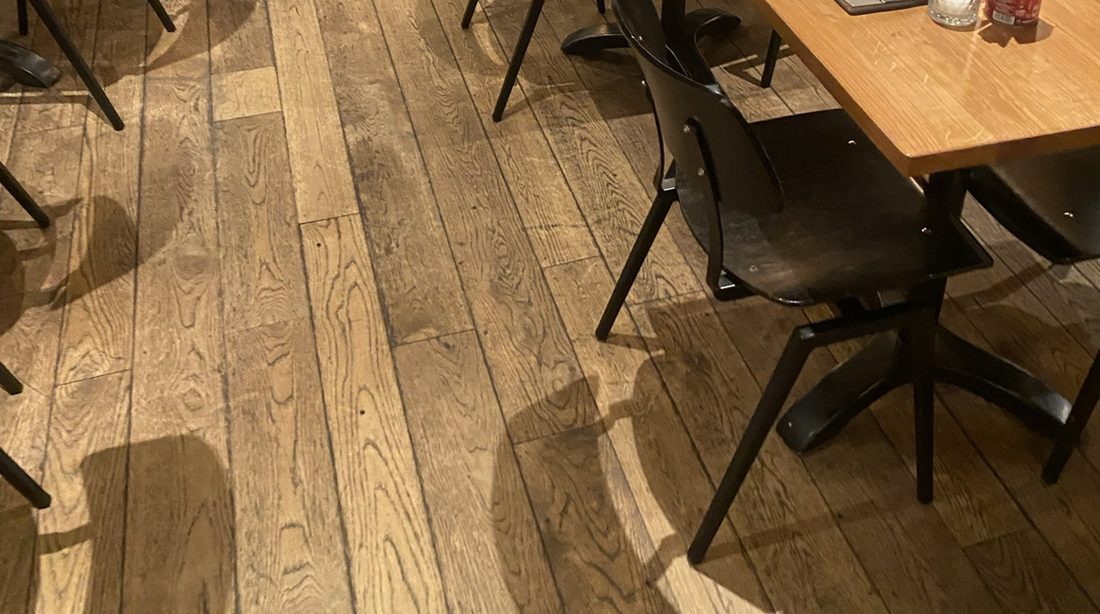
Stand at the pass in almost any dining room in the centre of Maastricht and look down the length of the floor with the light coming in from the street. You will see it: a pale, slightly chalky lane running from the bar to the busiest table, wider at the turns, with the planks either side of it still warm and honey-coloured. That lane is not dirt. It is oil that has gone, and the way it went is almost always the mop bucket.
The grey path between the bar and table six
It starts at the service door and it ends wherever the staff pivot. In a narrow room off the Markt it is one clean lane. In a wider place it fans out into a grey delta around the pass. The planks under the window seats, where nobody walks and nobody mops twice a night, are still the colour the floor was on opening day, and that is the giveaway. If the greying were sun or age, it would be worst by the window. It is worst where the mop goes.
Oak that has lost its oil does not look dirty, exactly. It looks tired and slightly dusty even ten minutes after a clean, because light no longer bounces off a filled surface — it scatters off open, thirsty wood fibre. And open wood fibre takes on everything: red wine, the drip line under a beer tap, the grey ring where a chair foot has been dragged back and forth a thousand times.
Oil is in the wood, lacquer is on it
A lacquered floor has a hard film sitting on top of the oak. You are never really touching wood, you are touching plastic, and the cleaning question is simply whether your cleaner is harsh enough to cloud that film. Lacquer fails dramatically — it wears through in a patch and the bare wood underneath goes black.
Oiled oak works the other way round. The oil has soaked into the top fibres of the plank and cured there. There is no film. The wood itself is water-repellent because its pores are full of hardened oil, and the surface you are polishing with your mop is oak, not coating. That makes it wonderfully repairable — you can nurse one bad metre back without touching the rest of the room — and it makes it vulnerable to exactly one thing: anything that dissolves fat.
Which is, unfortunately, the entire job description of every degreaser in the kitchen.
Why all-purpose cleaner takes the shine away
A general cleaner is built to lift grease off tiles and stainless steel. It is alkaline, it has surfactants, and it does not know the difference between the fat from a schnitzel and the cured oil in a plank of oak. Use it once and nothing happens. Use it every closing shift for a season, in the same lane, with a bucket that is mostly water by the end of the room, and you have slowly washed the finish out of the floor.
The same goes for the strong green degreaser that lives by the fryer, for the chlorine that goes down the kitchen drain, and for the concentrated stuff that is dosed by eye rather than by cap. Ammonia clouds it. Anything acidic — a descaler, vinegar because it seemed harmless — burns pale marks into the oil that you can still see a year later, at an angle, when the low winter sun comes in.
Soap, and a mop that is damp and not wet
The correct product for an oiled floor does the opposite of cleaning as most people understand it. It is a soap with fat in it, often based on vegetable oil or natural soap, and every wash leaves a very thin deposit behind. You are cleaning and feeding in the same pass. Over months the floor gets slightly deeper in colour rather than paler, and the lane by the bar stops announcing itself.
Here is what the pass actually looks like when we do it. First, dry: a wide sweeper or a vacuum with a brush head, along the grain, into every seam, because whatever grit you leave now you are about to grind in with a wet cloth. Then the soap solution, mixed to the dose on the bottle and not by feeling. Then the mop goes in the bucket and comes out, and gets wrung until it will not give up another drop, and then gets wrung again. Laid on the floor it should leave a film that is gone in well under a minute. If you can see a wet sheen trailing behind you, there is too much water on the wood.
We work in sections, along the plank direction, and we turn or rinse the mop far more often than feels necessary, because a grey mop head just moves the dirt to the next table. Seams and the joint at the skirting get attention with a cloth rather than a flood. Spilled water standing in a seam for ten minutes raises the grain and leaves a dark rim; that rim is not a stain, it is swollen wood, and the fix is sanding, not scrubbing.
Chair legs come up onto the tables where the room allows it. The floor under the banquette gets done properly, on a knee, because the dust that lives there comes back out every time the door opens.
The grit at the door does the damage
Nothing you buy in a bottle will protect a dining-room floor as well as matting at the entrance. Maastricht hands you the worst possible mix: wet cobbles, the fine grey dust off the Sint Pieter side, road salt in January, and a summer terrace where every guest walks in off gravel. That grit acts as sandpaper under a shoe, and it is the reason the lane wears faster than the corners, more than any cleaner ever will.
You want enough matting inside the door that both feet land on it — a small square mat is decoration. Add a scraper mat outside if the pavement allows. And the mats need to be lifted and cleaned themselves, because a loaded mat stops taking anything in and simply redistributes it. For the deeper dirt in matting and in an upholstered banquette, that is a job for extraction cleaning of carpet and upholstery, not for the same bucket you are using on the oak.
Spot repairs, and knowing when it needs oil again
The good news about oil is that damage is local and so is the fix. A red wine mark caught the same evening usually comes out with the soap itself and a little patience along the grain. An older one sits in the open fibre; that patch can be cleaned, lightly abraded with a fine pad, and re-oiled so it blends back into the plank. A black ring where a wet planter stood is deeper and wants a maintenance oil worked in, sometimes twice.
How do you know when a whole lane is due? Put a few drops of water on it. On a floor with oil left in it, the drops sit up and bead and you can wipe them away dry. On a worn stretch the water goes flat and soaks in dark within a minute or two — and that dark patch fading back as it dries is the floor telling you it is drinking. Do that test in the busy lane and again under a window table. If the two behave differently, the lane wants oil, not another wash.
Re-oiling frequency is not a fixed number anyone can quote you honestly. A ground-floor restaurant with a terrace and a wet season wears oil out of the traffic lanes long before a quiet upstairs room does. What matters is that somebody tests it rather than waiting for the floor to look bad, because by then the fibre is open and stained, and open, stained oak is a sanding job.
What should never touch it
Steam. A steam mop on oiled oak drives hot water into the seams, softens the oil and lifts the grain, and no amount of drying afterwards puts that back. We use steam where it belongs — tiles, grout, hard kitchen surfaces — and it stays off wood.
Also off the list: the black stripping pad, melamine sponges, scouring powder, a red pad on a rotary machine, anything sold as a floor polish or a shine restorer for vinyl, and a wet vacuum used as a mop. And no vinegar. A rotary machine is not banned outright, but on oiled oak it wants the softest pad and a person who knows what the floor is made of; that is not the same job as machine cleaning a tiled kitchen or a warehouse floor, even though it uses the same machine.
This is the sort of detail that gets lost between shifts, which is why our restaurant cleaning in Maastricht runs on a checklist per location rather than per cleaner. The team checks in with an NFC tag on the wall when they arrive, photographs the work, and those photos are reviewed against the checklist by AI before the job is closed — so if the floor was done with the wrong bucket, or the mats were skipped, it does not quietly become the house routine. Our team works in English as well as Dutch, and the company is insured and registered with the Chamber of Commerce; the 5.0 on Google comes from rooms that get opened at eight in the morning and look right.
Frequently asked questions
Can I just use green soap on my oiled oak floor?
Traditional green soap is far gentler than an all-purpose cleaner and many oiled floors have survived years of it. A soap made specifically for oiled wood is better still, because it is balanced to leave a little fat behind rather than only to clean. What matters more than the brand is the dose on the bottle and how hard you wring the mop.
How do I get red wine out of an oiled floor?
Blot it immediately, do not wipe it across the planks, then clean the spot with your wood soap along the grain. If a shadow stays after it dries, the wine is in the open fibre and the patch needs light abrasion and a little maintenance oil to blend back in. That is a small, local repair, not a reason to treat the whole room.
Why does my floor look dull again an hour after cleaning?
Usually because the oil is gone from that area and you are looking at bare oak fibre scattering the light, or because too much cleaner was used and a dry soap residue has hazed over. Try the water-drop test: if the water soaks in dark, it is wear, and the answer is oil rather than more washing.
Is a scrubbing machine safe on an oiled plank floor?
With a soft white pad, the right soap and very little moisture, a machine can be used — but it is not the same setting or pad as on tile, and the wrong pad will burnish and lift oil in a single pass. Tell whoever cleans the floor exactly what finish it has, before they arrive with the machine.
How often does a restaurant floor need re-oiling?
There is no honest fixed answer, because a traffic lane by a terrace door wears in a fraction of the time an upstairs corner does. Test the lanes with water every few months and oil the stretches that stop beading. Catching it while the wood is still closed keeps it a maintenance job instead of a sanding job.