





The short answer
- Ceiling light hides dust; light raking across a surface shows it. In winter you have to go looking for the angle.
- The first three metres inside a door do most of the winter damage. Grit gets walked in, then walked around.
- Vacuum before you mop. A wet mop over road grit is a sheet of sandpaper on your floor.
- Keys and alarm codes need one written procedure and one phone number, not a habit that lives in somebody's head.
- Freezing weather is the wrong moment for outside glass and for soaking a carpet that has nowhere to dry.
What’s in this guide
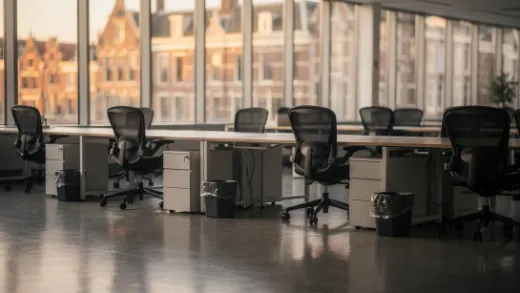
On the last Sunday of October the clocks go back, and by the Wednesday after, the office on the Akersteenweg is already dark when the last laptop bag goes out the door. Nothing about the building has changed. The light has. And almost everything about how an evening clean is done — what you can see, how you get in, what comes in on shoes — changes with it.
The light goes first
In September the evening team arrives at six and the windows are still doing half the work. Daylight comes in low and sideways across a desk, and every smear on the glass partition, every ring left by a coffee cup, every grey fan of dust on the windowsill announces itself. You do not have to hunt for anything. You just clean what the light has already pointed at.
From the end of October that help is gone. The room is lit from above by flat white panels, and overhead light is the most forgiving light there is. It falls straight down onto a surface and flattens it. Dust on a black meeting-room table becomes invisible. Fingerprints on a glass door disappear completely — until nine the next morning, when somebody walks up to that door with the low winter sun behind them and sees every one.
So the method changes. You crouch, and you look along the glass towards the corridor lamp instead of straight at it. You wipe a desk and then move your head, not your hand, to check it. On dark stone and dark vinyl you drag the light: a torch held low, almost parallel to the floor, which turns a floor that looked clean into a floor with a tide line along the skirting. Half the switches are off because the last person out hit the wrong bank, so the first thing the team does in a dark office is turn the lights back on — all of them, including the ones over the printers and in the kitchenette that nobody uses after five.
That sounds obvious. It is also the single most common reason an office clean quietly gets worse in November without anybody being able to say what happened.
Keys, alarm codes and the door that swings shut
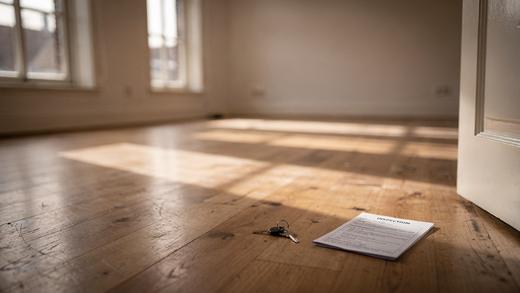
Winter is when access arrangements get tested, because now the cleaner arrives to a building with nobody in it. In July somebody was usually still there at six. In December the last person leaves at half past four, sets the alarm, and the team is the only human being in the place for the next hour and a half.
What that needs is boring and specific. One written procedure, on paper or in an email that can be found again: which door, which key or fob, which alarm partition, in which order. Whether the server room is on its own zone that must not be opened. Whether the front door in an old building on the Boschstraat swings shut behind you and locks, which it will, on the one evening the key is on the desk inside. One phone number that will actually be answered if the panel starts beeping — a person, with a name, not the general office line.
We ask for this before the first visit rather than after, and we ask it in whichever language is easier for the person who holds the keys: the team works in English as well as Dutch, and an alarm code is a bad place for a translation to go wrong. We are insured, and registered with the Dutch Chamber of Commerce, which is the part of this that matters when you are handing a key to somebody for a building you are responsible for. If something in your office gets knocked off a shelf by us, you are not the one absorbing it. Ask any cleaning company in Maastricht that question before you hand over a fob, and listen to how quickly they answer.
Grit, salt and wet shoes
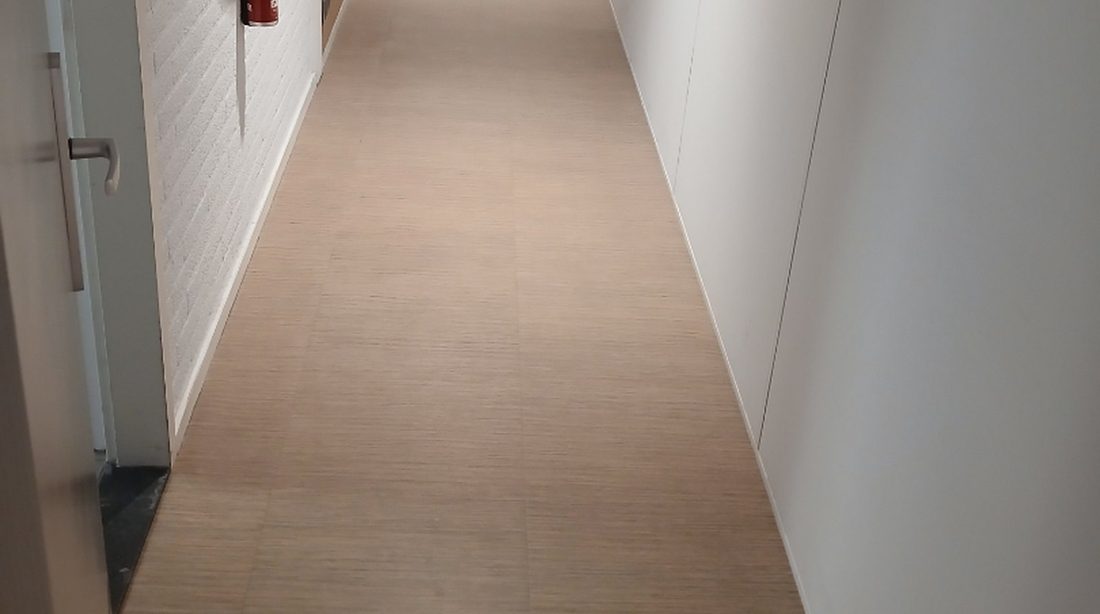
The rest of winter arrives on the soles of shoes. Once the gritters have been out on the Scharnerweg, every pair of shoes that crosses your entrance hall is carrying road salt, sand and a film of wet grey. It does not stay at the door. It gets walked to the lift, to the coffee machine, to the meeting room, and it dries into that dull haze on a hard floor that looks like the floor needs replacing and actually just needs a different order of operations.
The order matters more than the product. Grit is a mineral, and it is harder than your floor finish. Put a wet mop over it and you have made a slurry of fine sandpaper and are now polishing scratches into the vinyl with your own hands. So: vacuum first, properly, especially the first three metres inside the door and the strip along the skirting where footfall pushes everything. Lift the entrance mat and vacuum underneath it, because that is where the sand collects and where nobody looks. Then mop, with clean water changed more often than in summer — a bucket that has gone grey is just moving dirt around the room.
Doormats earn their keep in these months and only if they are treated as equipment rather than decoration. A saturated mat stops absorbing and starts donating. If your entrance is tiled and the haze has already built up over a few weeks of this, a mop will not lift it; that is a job for a machine with a brush and suction, once, after which normal mopping works again. Carpet tiles at the entrance take the same beating, and they go dark in a wedge shape that follows the walking line. That is extractable, but read the last section before you book it for January.
Checking in when nobody is there to see it
Here is the real problem with the dark months, and it has nothing to do with dirt. You are not there. You leave at half past four and you come back at eight the next morning to an office that looks fine, and you have no idea whether it looks fine because it was cleaned well or because nobody used it overnight. The kitchen worktop is wiped. Was the fridge door handle done? Was the meeting room even entered? In summer somebody working late sees the team and the question does not come up. In winter it comes up every week, and it is the thing that makes people start doubting a cleaning service in Maastricht that is, in fact, doing the job.
We took that question away rather than arguing about it. There is an NFC tag on the wall in your building. The team taps it at the start of the visit, so the check-in is tied to your address and not to a timesheet written afterwards. The work is photographed, and those photos are reviewed by AI against the checklist for your office before the job is closed — so if the checklist says the glass partition in the meeting room and there is no photograph of the glass partition in the meeting room, the job does not quietly close with a gap in it.
What that gives you in February is simple. You do not have to inspect your own office on a Monday morning with a suspicious look on your face. If something was missed, you can point at it, we can see the same evidence you can, and it gets fixed instead of discussed. Our 5.0 on Google is mostly built on that: not on anybody being charming, but on people not having to chase.
What to move in the schedule, and what to leave alone
A cleaning plan written in June is wrong by November, and usually in the same three places.
The entrance floor needs more attention and the desks need no more than they did. Wet shoes do not put dirt on a monitor. Shifting a little time from the open-plan floor to the hall and the lift lobby costs nothing and is the difference between a building that looks maintained and one that looks tired.
Inside glass is worth more in winter than in summer, because the low sun in the morning hits partitions at exactly the angle that shows every hand mark, and because people close doors more when the heating is on. Outside glass is the opposite — see below.
And the bins change. Heating on, windows shut, and the kitchen bin with someone's soup container in it is a different object by Friday than it was in August. If you have gone to a lighter schedule over the summer, the kitchen and the bins are the parts to put back first. If your building takes deliveries all winter and the staff kitchen is doing double duty, a deeper clean once between the clocks changing and the spring is worth more than a slightly longer weekly visit.
Three things winter is the wrong moment for
Outside windows in a hard frost. Water freezes on the glass, the squeegee skips, and you get a streaked window and a sheet of ice on the path underneath it, which is a worse problem than a dirty window. Exterior glass work waits for a mild day, and there are plenty of those here between the cold snaps.
Soaking a carpet in a building with the heating off at weekends. Extraction leaves fibre damp, and damp fibre in a cold, sealed office dries slowly and starts to smell of exactly what you were trying to remove. Do it when the heating will run for a day afterwards and a window can be cracked, not on the Friday before the Christmas shutdown.
And steam is not the answer to everything, whatever a shop demonstration suggests. On grouted tile and on sanitary ware it is excellent. On an engineered wood floor, or laminate with joints that have already lifted slightly at the edges, hot vapour is the last thing that floor needs. Anyone offering to steam your whole office is not thinking about your floor. Ask them what is underneath it.
None of this is exotic. It is just the difference between cleaning an office and cleaning an office in December, and our team works mostly in buildings around here, where the winter is wet rather than dramatic and the damage is done slowly by grit and dark corners rather than by snow. The same applies from Sittard down to Valkenburg, where the pavements get salted just as thoroughly and the mats give up just as fast.
Written by the office cleaning lead at Elizabet M Cleaning in Maastricht; if your evening clean is about to be done in the dark, send us the floor plan and the access arrangement and we will put a winter schedule against it.
Frequently asked questions
Can cleaners work after hours if the alarm is set?
Yes, and that is normal in winter. What it needs is written down beforehand: which entrance, which key or fob, which alarm partition and in which order, any zone that must stay closed, and one named person who answers the phone if the panel behaves oddly. We ask for that before the first visit, in English or Dutch, whichever is easier for whoever holds the keys.
How do I know the office was actually cleaned when I wasn't there?
There is an NFC tag on the wall in your building. The team taps it at the start of the visit, so the check-in belongs to your address. The work is photographed and the photos are reviewed by AI against your office's checklist before the job is closed, so a missed item shows up as a gap rather than disappearing.
Should we have the office windows cleaned in winter?
Inside, yes — low winter sun through a glass partition shows every hand mark. Outside, wait for a mild day. Washing exterior glass in a frost gives you streaks and an icy path, and neither is an improvement.
The entrance tiles have gone dull and mopping doesn't help. Why?
It is usually road grit and salt walked in, then spread by a wet mop until it forms a haze. Mopping cannot lift it because the mop is what put it there. A single pass with a floor machine, brush and suction, resets the floor, after which vacuum-then-mop keeps it that way.
Do you clean offices outside Maastricht?
Yes — we cover Maastricht and the rest of Limburg, including the villages between here and the border. The winter problems are identical everywhere the roads get salted.