







The short answer
- The condenser is usually behind the low grille at the front or bottom of a refrigerated counter, or in the plinth or back panel of an upright fridge.
- Dust does not stop a fridge. It makes it work harder, run longer and fail on the day the terrace is full.
- Unplug it. A thermostat switch does not stop the compressor being live.
- Dry first: soft brush along the fins, vacuum with a brush nozzle. No hose, no steam, no degreaser sprayed into the coil.
- In a kitchen with a fryer, look monthly. In an office kitchen, a few times a year is usually enough.
What’s in this guide
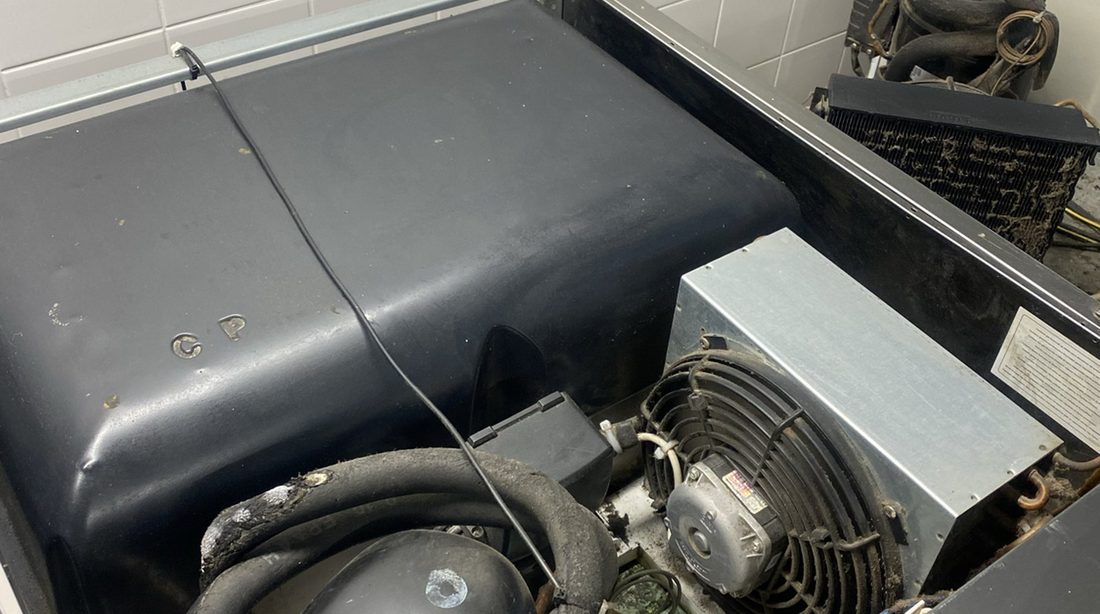
Kneel down in front of a refrigerated counter in any kitchen in Maastricht, put your cheek near the floor and look at the grille at the bottom. Behind it there is a small radiator, and over the fins of that radiator there is usually a layer of grey felt: flour, fryer mist, hair, the fluff off tea towels, the dust that comes in off the street every time the back door swings. The fridge above it is spotless. The part that keeps it cold has not been touched since it was delivered.
Where it sits, and why you have never looked
A commercial fridge makes cold by moving heat out of the cabinet and dumping it into your kitchen. The part that does the dumping is the condenser: a small radiator of thin aluminium fins with a fan behind it. It has to breathe. If it cannot get rid of its heat, nothing else in the machine works properly, no matter how clean the shelves are.
On a refrigerated counter or saladette, it is nearly always behind the low grille — sometimes on the front, sometimes on one end, sometimes underneath at the back where you have to lie down to see it. On an upright fridge or freezer it hides in the plinth at the bottom, behind the kick panel, or as a black coil across the back wall. On the old upright in the office kitchen it is the thing you can feel blowing warm air at your ankles while you wait for the kettle.
Nobody looks because nobody has to. The fridge runs. The temperature display reads what it should read. Everything wrong with it is happening in a space the width of two fingers, twenty centimetres off a floor that gets mopped around it.
The grey felt, and the hottest day of the year
Dust on a condenser does not break a fridge. That is exactly what makes it dangerous. It insulates the fins, so the heat stays in the refrigerant instead of leaving through the aluminium. The compressor answers the only way it can: it runs longer. Then it runs almost continuously. The cabinet still holds temperature, the kitchen notices nothing, and the machine quietly spends months working at the edge of what it can do.
Then comes the last week of July. Thirty-one degrees outside, every terrace between the Vrijthof and the Maas full from noon, both ovens on, the back door propped open because the kitchen is unbearable. The air the condenser is trying to breathe is already hot, it is breathing it through a felt blanket, and somewhere in the middle of service the fridge stops holding. It does not announce it. You find out when someone opens the drawer of portioned fish at four in the afternoon and it is no longer cold, and then you are standing in a corridor phoning an engineer who is having the same day as you are.
That is the whole reason to care about a strip of aluminium behind a grille. Fridges fail when the load is highest, and the load is highest on the day you can least afford to lose a full counter of prep.
Off at the plug, not off at the switch
Before a brush goes anywhere near a condenser, the machine comes off the power. Not switched off at the control panel — unplugged. A thermostat or a front switch tells the fridge to stop cooling; it does not make the compressor terminals, the fan motor and the wiring behind that grille dead. Those things sit right where your hands are going.
The fan matters too. Condenser fans are small, light and quick to spin up, and they start without warning when the compressor calls. Fingers, brush bristles and cloths all fit through the blades. Pull the plug, let the fan wind down, then work.
Two practical points people forget. First, on a counter fridge, emptying it is usually not necessary if you are quick — a closed, well-loaded cabinet holds temperature for a while, and a loaded one holds it better than an empty one. Second, if the fridge is on a hard-wired supply or sits in a bank of units with one isolator, the sensible move is to leave it alone and get the person who maintains it. There is no version of this job worth an electric shock in a wet room.
What a person actually does, in order
The grille comes off first, or the kick panel, usually two screws or a couple of clips. It goes in the sink with hot water and degreaser, because it is metal, flat and washable, and it is the only part of this job that a cloth belongs anywhere near.
Then a torch, held low, to see which way the fins run. They always run one way, and you clean along them, never across. A stiff-ish soft brush — a paintbrush or a proper coil brush, not a scouring pad — goes gently down the face of the coil, top to bottom, following the fins. The felt comes away in sheets. Bend a fin and it stays bent, and a bent fin is a closed gap in the airflow, so the pressure stays light.
A vacuum with a brush nozzle follows the brush, catching the grey stuff before it lands in the floor gully. Then the fan blades: each one wiped with a barely damp cloth, dried, and the guard around it brushed clear. Then the drip tray, if there is one, which is often where a smell in a kitchen has been living all along. Last, the floor under and behind the unit, which is the only time in a year that gap is reachable — and the thing that comes out of it is never just dust.
Panel back on, screws in, plug in. Hand near the grille after ten minutes: the air should be moving and warm. That is the check.
Not a job for a wet cloth
A wet cloth on a dusty coil makes mud. The mud packs into the gaps between the fins, dries hard and now you have something a brush cannot lift at all. Every cleaning problem that gets worse with water starts the same way, and a condenser is the clearest example in a kitchen.
The other three temptations are worse. A hose or a bucket of water near live wiring and a motor is simply not on. Steam belongs on grout, on tiles, on some floors — we use it where it helps and we use it a lot — but it does not belong pushed into an electrical compartment, and it certainly does not belong in a coil where condensate and aluminium will corrode together. And spraying foaming degreaser into a condenser gives you a coil full of chemical that never rinses out, dries sticky and collects dust faster than before you started.
Compressed air will get dust out of a coil. It will also put that dust onto the chef's mise en place two metres away, which is why it belongs to a maintenance visit in an empty kitchen, not to ten minutes on a Tuesday afternoon. Dry brush, vacuum, patience. That is the method.
How often, and who signs it off
It depends entirely on what the fridge is breathing. In a kitchen with a fryer, a flat-top and a flour bin, look at the grille every month; you will usually be cleaning it every month too. A pizza counter next to a hot oven, the same. An office kitchen fridge and the under-counter unit behind a bar are slower — a few times a year is normally enough, and the honest answer for how often is: look, and let the felt tell you. A fridge that stands in a carpeted room with no cooking near it might go six months and still look fine.
Put it on a list and put it with a name. Deep-clean days are where it belongs, alongside the extraction canopy, the wheels under the counter and the area behind the cooker — the jobs that live in a deep clean rather than in a nightly close-down, and that get skipped precisely because nobody sees them not being done.
That is the part we built our own routine around. When our team arrives at your kitchen or your office, the first thing that happens is a tap on the NFC tag on the wall, so the visit is logged where it happened and not on someone's memory. The work gets photographed, and those photos are reviewed against the checklist for that site before the job is closed — so a grille that came off, got brushed and went back on is a visible fact, not a claim. We work in English as well as Dutch, we are insured and registered with the Dutch Chamber of Commerce, and the 5.0 on Google comes mostly from the parts of a building people only notice once they have been handled. For restaurant kitchens and business premises across Maastricht and the rest of Limburg, that is how the awkward twenty centimetres above the floor stops being nobody's job.
Go and look at your own grille tonight, before service. If you cannot see aluminium, the felt has been there a while.
Frequently asked questions
How do I know if my condenser needs cleaning without taking anything apart?
Shine a torch through the grille at a low angle. If you can see individual metal fins with gaps between them, it is fine. If you see a flat grey surface, that is dust, and the fridge is already working harder than it needs to. A compressor that seems to run almost non-stop, or a warm patch on the cabinet, points the same way.
Can I just vacuum it without unplugging the fridge?
Don't. The condenser fan can start at any moment when the compressor calls for it, and there is live wiring in that compartment. Unplug the machine, let the fan stop, then work. If it is hard-wired or shares an isolator with other units, leave it to whoever maintains the equipment.
Is steam cleaning safe for a cooling unit?
No. Steam is excellent on grout, tiles and some hard floors, and we use it there, but it has no place inside an electrical compartment or pushed into a coil. Moisture plus aluminium plus dust equals corrosion and packed mud. The condenser is a dry-brush-and-vacuum job.
Do we have to empty the fridge first?
Usually not, if the work is planned. A loaded cabinet with the door kept shut holds its temperature for a while, and the coil is reached from outside the cabinet anyway. Still, schedule it outside service and check the temperature once the power is back on.
Can you include this in a regular cleaning contract?
Yes — it fits naturally into a deep-clean visit rather than a nightly close-down, and it goes onto the checklist for your site so the photographs from that visit show the grille off and the coil clear. Ask for it by name when you request an estimate.