






The short answer
- Cement tiles are not glazed. The colour sits in a soft cement top layer, and acid dissolves it.
- Vinegar, descaler and toilet cleaner are the three bottles that do the real damage. Splashes count.
- Grit is sandpaper. Sweep first, always, before any water touches the floor.
- Steam is wrong for these tiles: it strips wax and drives moisture into a porous surface.
- A pH-neutral soap, two buckets and a well-wrung mop will keep them for another lifetime.
What’s in this guide
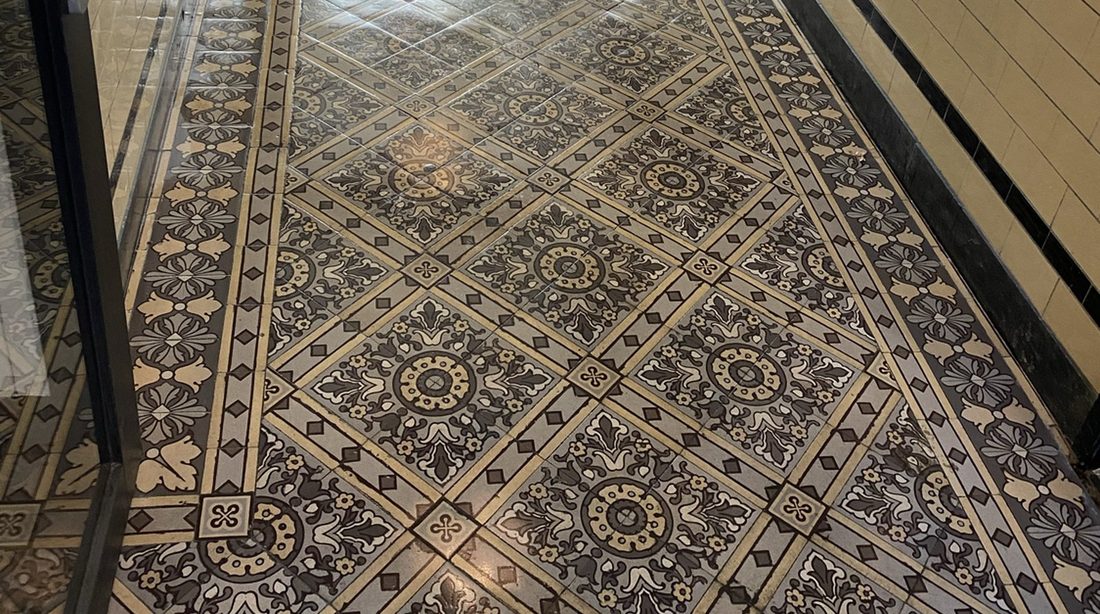
You know the floor. Dark red and cream, or ochre and grey-blue, laid in a border that runs from the front door to the foot of the stairs, with one tile near the meter cupboard that somebody replaced in the seventies and never quite matched. Half the older houses in Maastricht have a version of it. And most of the damage those floors carry is not from a century of feet — it is from a bottle somebody bought at the drogist with the best intentions.
What you are actually walking on
A cement tile is not a ceramic tile. Nothing about it has been through a kiln. It was made in a press: a thin top layer of white cement, marble powder and pigment poured into a brass mould, then a coarser backing of sand and cement pressed on behind it, and the whole thing left to cure slowly in damp air. That coloured layer is a few millimetres thick. It is coloured all the way through, which is the good news — a scratch does not show a white line underneath the way a chipped glazed tile does.
The bad news is in the same sentence. There is no glass on top. No glaze, no fired skin, nothing sealed shut by heat. What you are walking on is cement, and cement is porous, mildly alkaline and soft enough to take a mark. Spill red wine on a badly maintained one during a party and you will still see the ghost of it at Christmas. Put a bicycle down on its pedal and the pedal wins.
People treat these floors as if they were indestructible because they are old, and they have survived a hundred years of children, coal deliveries and wet dogs. They survived because somebody kept a film of wax on them and washed them with soap. The moment that habit stops, the floor starts drinking everything that lands on it.
Why vinegar and limescale spray leave a mark
Here is the one thing worth taking away from this whole piece. Acid eats cement.
Vinegar is acid. Schoonmaakazijn is stronger acid. Anti-kalk sprays are acid, usually with a pleasant lemon smell. Toilet cleaner is acid, and it is thick so that it clings, which is exactly what you do not want on a floor. Grout removers and "cement veil removers" are acid by design — they are made to dissolve cement, and your tile is cement.
What happens is not a stain. A stain sits on top and can be lifted. This is etching: the acid opens up the surface, takes a little of the binder with it, and the pigment that was held in that binder goes dull and slightly rough. Run a fingertip across it and you can feel the difference before you see it. In a dark tile it reads as a pale cloud. In a pattern it reads as a smear that goes straight across the border and ignores the design, which is what makes it so obvious from the stairs.
And it is rarely a deliberate mopping. It is the splash when somebody sprays the mirror in the hallway and the overspray lands on the floor. It is the drip carried on the rim of the bottle from the toilet to the kitchen. It is the friend who helps out, sees a white haze on the tiles, assumes limescale, and reaches for the strongest thing under the sink. That white haze, by the way, is usually not limescale at all — it is either dried soap residue from mopping with too much product and not enough rinsing, or lime that has migrated up through the tile from the old sand-and-cement bed underneath. Neither of them is fixed with acid. One is fixed with clean water, the other with patience.
Bleach is the second bottle to keep away. It will not dissolve the tile, but on pigments this old you are gambling with the colour, and the borders are the tiles nobody can replace.
The weekly wash, in order
The routine is genuinely simple, and the order matters more than the products.
- Sweep or vacuum first, properly, including under the mat. The grit that comes in on shoes from the Maasboulevard, and the salt that gets scattered on the pavements in January, is quartz sand. Dragging a wet mop over it makes an abrasive paste and grinds a matt track down the middle of the hall. More cement floors are worn out by their own mop than by anything else.
- Two buckets. One with warm water and a pH-neutral cleaner — a neutral floor soap, or a proper soap made for natural stone and cement tiles. Small dose. The second bucket holds clean water for rinsing the mop head. Dirty water going back into the soap bucket is how you get that milky film.
- Wring it out until it is damp, not wet. Cement tiles should be moist for a moment and dry within a minute or two. Water standing in the joints soaks in and comes back later as a pale bloom.
- Work from the far end towards the door, in the direction of the pattern rather than against the border, and change the water when it turns grey. Twice for a hallway with a vestibule is normal.
- Dry the edges. The skirting line and the strip in front of the door take the most water and show it first.
Things to leave in the cupboard: steam. A steam cleaner is excellent on a modern glazed tile and wrong here — the heat lifts wax straight off, and driving hot vapour into a porous, unsealed surface pushes moisture where you have spent years trying to keep it out. Also leave the scouring pad, the rotating brush you bought for the terrace, and any bottle whose label boasts about removing lime.
Grout, thresholds and the strip by the front door
In these houses the tiles were usually bedded straight into sand and lime mortar, with joints so narrow they were barely grouted at all. After a hundred years the joint by the doormat is often open, slightly crumbly, and full of dark dust that will not mop out. That is where people reach for a grout cleaner, and a grout cleaner is exactly the acid we have just spent three paragraphs avoiding.
Do it dry instead. A stiff, non-metal brush along the joint, a vacuum behind it, then the normal wash. If the joint is genuinely open — you can get a fingernail in — that is repointing work, not cleaning work, and it is worth doing before the floor starts to rock, because a loose cement tile cracks along the width and then you are hunting for a replacement in a reclamation yard in Eijsden.
The threshold under the front door deserves its own minute. Salt and de-icing grit sit there all winter, get wet every time the door opens, and quietly dull that first metre. A mat outside and a mat inside does more for a cement floor than any product.
Sealing and wax: what they do and do not do
Two different things, and people mix them up constantly.
An impregnating sealer soaks in and sits inside the pores. It does not make the tile shiny and it does not make it waterproof. It buys you time — the minutes between a spill landing and a spill soaking in. On a hallway floor that is most of the battle.
Wax, or a soap-based finish, sits on the surface, gives the tile the low satin depth these floors are supposed to have, and takes the wear instead of the tile. It needs topping up. That is the whole maintenance secret of these floors, and it is why a soap with a little fatty content beats a stripping detergent: every wash puts a fraction back.
Neither one survives acid, and neither one is a reason to be relaxed with the bottle. A sealed tile that gets vinegar on it is a sealed tile with a dull patch.
What to hand to somebody else
A weekly wash is yours. What is worth handing over is the first deep clean of a floor that has had a few bad years — decades of wax build-up gone grey and sticky, paint spots from when the hall was last done, a builder's haze left after a bathroom went in upstairs. That work is done in stages, with neutral and mildly alkaline products, mechanical agitation instead of chemistry, a lot of rinsing and a lot of drying, and it is easy to do real harm quickly. Our deep cleaning and machine floor work exist for that kind of floor; the regular home cleaning is what keeps it from getting there again.
If you are renting one of these houses and the hallway floor is already etched, do not start experimenting on it. In general terms, Dutch tenancy practice separates normal wear from damage, and a landlord and tenant can disagree in good faith about which one a dull patch is; that is a description of the shape of the rule and not advice. The Huurcommissie handles rent and deposit disputes, and het Juridisch Loket is the place for anything else. Get it in writing before the deposit conversation starts, not after.
When our team is in your hall, you can see what happened there. Every visit is checked in on the NFC tag on the wall, the work is photographed, and those photos are reviewed against the checklist for that job before it is closed — so "the hallway was done" is something you can look at rather than take on faith. Our team works in English as well as Dutch, and the company is insured and registered with the Chamber of Commerce, which matters on a floor where a wrong bottle is not a mistake you can wipe up. The 5.0 on Google is there for the same reason the photos are.
If you are not sure what is on your floor — wax, sealer, or a hundred years of nothing — pick the tile behind the door that nobody sees, wash it the way described above, and look at it in the morning light. That one tile will tell you most of what you need to know.
Frequently asked questions
Can I really never use vinegar on cement tiles?
Not on the tile, no. Vinegar, cleaning vinegar, descaler, toilet cleaner and cement-veil removers are all acidic, and acid dissolves the binder that holds the pigment in a cement tile. The result is a dull, slightly rough patch that cannot be washed away. If some has already landed, rinse with plenty of clean water immediately — it limits the damage, it does not undo it.
What should I mop patterned hallway tiles with?
Warm water and a small dose of a pH-neutral floor soap, ideally one made for natural stone or cement tiles with a little fat content that feeds the finish. Two buckets, one to wash and one to rinse the mop. Wring out well: damp, not wet.
There is a white film on my tiles after mopping. Is that limescale?
Usually not. It is most often soap residue from too much product or from rinsing the mop in the dirty bucket, and it comes off with clean water and a second pass. It can also be lime rising from the old mortar bed underneath, which returns slowly and is not treated with acid. Either way, a limescale remover will make things worse.
Can a steam cleaner be used on cement tiles?
We would not. Steam lifts wax off the surface and pushes hot moisture into a porous tile, which is the opposite of what these floors need. It is a fine tool on modern glazed tiles and the wrong tool here.
How do I know if my floor is sealed?
Drop a little water on a discreet tile, behind the door or under the coat rack. If it beads or sits for a while, there is something on the surface. If it darkens the tile within seconds and the dark patch takes a long time to fade, the floor is drinking, and a sealer is worth considering before the next winter of grit and salt.
Do you clean these floors in older houses outside Maastricht?
Yes — the same tiles turn up in houses all through Limburg, and our working area covers the villages around the city as well. Ask for an estimate and say what condition the floor is in.