

The short answer
- Fresh sweat has almost no smell. The odour comes from bacteria feeding on it.
- Bacteria live on porous surfaces — rubber, grout, foam, worn vinyl — not in the air.
- A spray-and-wipe with a dry cloth redistributes the film instead of removing it.
- The floor is the largest surface in the building and usually the least cleaned.
- Deodorising a gym works for days. Changing the method works permanently.
What’s in this guide
Every gym owner has had the same conversation. A member mentions the smell, politely, on the way out. You walk the floor and you cannot smell anything, because you have been in it for two hours. So you buy a diffuser, and for about three days the place smells of sandalwood and gym, which is worse. The reason nothing works is that the problem is being treated as an air problem when it is a surface problem, and surfaces do not respond to fragrance.
Sweat is not the smell
Start with the biology, because it decides everything else. Sweat leaving the body is essentially odourless — it is mostly water, with salt and a small amount of the compounds skin produces. It smells of nothing much at all.
What smells is what happens next. Bacteria that live perfectly happily on skin, fabric and equipment feed on those compounds, and the by-products of that digestion are the sharp, sour, faintly ammoniac notes everybody recognises as "gym". The smell is not the sweat. It is the meal being eaten, several hours later, by something living on a surface.
You are not smelling people. You are smelling a colony that people fed this morning.
Two consequences follow immediately. First, fragrance cannot help, because you are adding a smell on top of an ongoing biological process rather than stopping it. Second, and more usefully: if you remove the food and the film it sits in, the smell has nowhere to come from — and it goes within a day, not over weeks.
It lives on surfaces, and some surfaces are worse
Bacteria need somewhere to sit that holds moisture. Smooth, sealed, dry surfaces are hostile. Anything porous, textured or slightly worn is an excellent home.
Rank the surfaces in a typical gym by how hospitable they are and the list is almost exactly the list of things that smell: rubber flooring with its fine texture, grout lines in changing rooms, foam inside worn upholstery, fabric straps and handles, and any vinyl that has lost its surface and gone matt. Stainless steel and painted metal, by contrast, are rarely the problem.
This tells you where to spend the effort. Cleaning every square centimetre of a gym equally is expensive and unnecessary. Cleaning the porous half of it properly is the whole job.
The rubber floor is doing most of the smelling
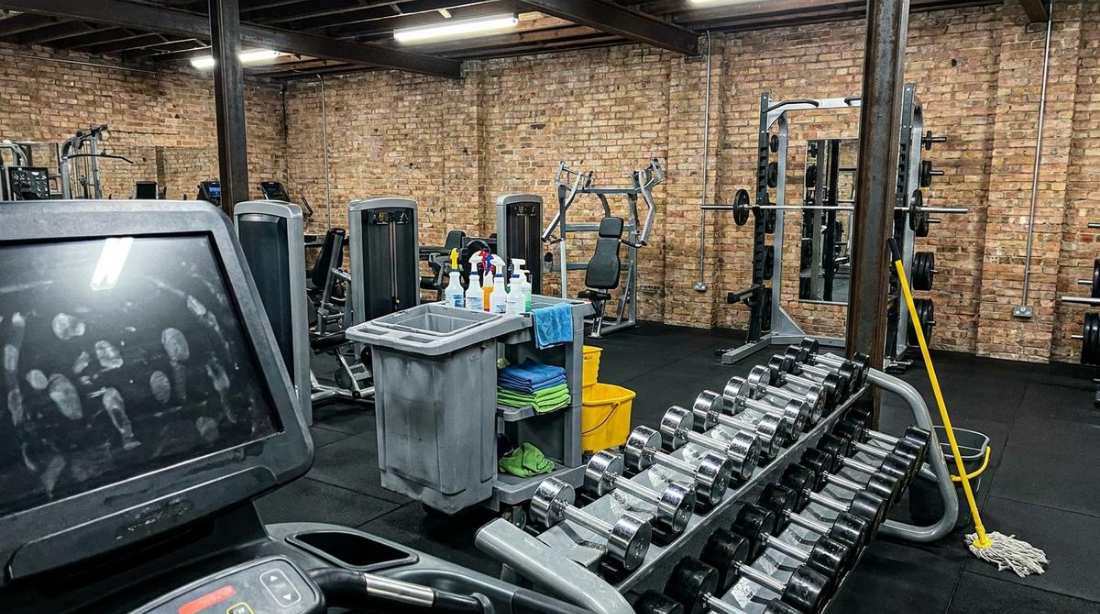
The floor is the largest surface in the building, everything drips onto it, and in most gyms it is dry-mopped and left. That is the single biggest reason a gym smells.
Gym rubber is deliberately textured for grip, which means it has thousands of tiny recesses per square metre — each one a small well that holds sweat, skin and whatever came in on shoes. Dry-mopping lifts the loose dust off the high points and nothing else. Wet-mopping with a general-purpose cleaner does a little more, but if the water is not lifted back out it dries in place, and what dries is a film of dilute everything.
What works is mechanical: water, agitation, and removal of the dirty water. On a small floor that means a microfibre flat mop with genuinely frequent water changes and a scrubbing motion rather than a swipe. On anything larger it means a scrubber-dryer, which does the same three things properly and in one pass. The difference is visible within a week, and it is the difference between a floor that is wiped and a floor that is cleaned.
One caution: strongly perfumed floor cleaner on textured rubber is a trap. It leaves a residue that is itself slightly sticky, holds more dirt, and produces exactly the sandalwood-and-gym combination that members remember.
Vinyl pads, benches, and the thing members do
Upholstery is the second front. Bench pads, backrests and grips take direct contact with skin all day, and most gyms rely on members wiping them down. Members do wipe them down — with a dry paper towel, quickly, because someone is waiting.
A dry wipe moves the film around. It is better than nothing, and it should absolutely stay, but it does not clean a surface and it should not be the only thing that ever happens to a bench. Two things make the difference:
- Wet contact time. A disinfectant needs to sit on a surface for a stated period to do its job. Sprayed and immediately wiped dry, it has done almost nothing. Spray, leave it while you do the next one, then wipe.
- The seams and the underside. Fluid runs down and collects where the vinyl meets the frame, under the lip, in the stitching. Nobody wipes there and that is where the colony is comfortable.
Worn vinyl is a separate conversation. Once the surface has gone matt and slightly tacky, it is porous, and it cannot be cleaned back to clean. Replacing pads is cheaper than the members who quietly stop coming.
Changing rooms, and the drain nobody checks
If the smell is worst near the showers, it is probably not the showers. Two suspects, both hidden.
Grout. Tile is sealed; grout is not, unless someone sealed it. Warm, wet, porous and fed daily, it is close to ideal, and a mop passing over the tile does not reach into it. Grout needs occasional dedicated work — a brush, a proper contact time, and rinsing — and after that it needs sealing, or the same thing happens again.
The floor drain. A drain that is rarely used dries out. The water sitting in the trap is the only thing between the room and the sewer, and when it evaporates the smell comes straight up. It is intermittent, it is worst after a quiet period, and it is fixed by pouring a jug of water down every unused drain once a week. It costs nothing and it solves a problem people have spent a great deal of money failing to solve.
A routine that actually holds
The honest version, in the order that matters:
- Daily: wet-clean the floor properly with water that gets changed. Wipe all high-contact grips and handles with real contact time. Empty bins — a bin of used paper towel is a smell source in its own right.
- Weekly: upholstery seams and undersides. Behind and under the fixed equipment, where nobody looks and everything collects. A jug of water down each unused drain.
- Monthly: grout, mirrors at height, ventilation grilles, and the tops of things — extraction only works if air can get through it.
- Quarterly: an honest inspection of the vinyl. Matt and tacky means replace, not clean harder.
None of that is exotic. It is ordinary commercial cleaning done in the right order with the water actually being removed, and it is why a gym cleaned this way smells of nothing at all — which is the correct smell for a gym, and the one members never mention because they never notice it.
Frequently asked questions
Will an ozone or air-purifying machine fix it?
It can reduce airborne odour temporarily, but it does not remove the film on surfaces that keeps producing it. If the surfaces are dealt with, you generally find you do not need the machine.
How often does gym rubber need machine cleaning?
Daily wet cleaning of the busy areas, with a deeper machine scrub weekly in most gyms and more often in a very busy one. The key variable is whether the dirty water is being lifted back out rather than left to dry.
Are member wipe-down stations worth keeping?
Yes — they help, and they set a tone. Just do not treat them as the cleaning. They are a courtesy between users, not a substitute for contact time and seams.
What about the smell in the ventilation?
Grilles and filters collect a greasy dust that holds odour and restricts airflow. They are usually a monthly job and are routinely skipped because they are above head height.
Can you clean outside opening hours?
Yes, and for a gym that is usually the only workable option. Early mornings and late evenings are normal for this kind of contract.